A dead forklift battery in the middle of a shift is more than an inconvenience. It stalls your entire operation, frustrates your crew, and quietly erodes your bottom line. The good news is that most battery-related downtime is completely preventable.
Proper electric forklift charging practices extend battery lifespan, reduce energy costs, and keep your fleet running at peak capacity. Whether you manage a single forklift or a multi-shift warehouse operation, the charging decisions you make every day determine how long your batteries last and how much you spend replacing them.
This guide covers everything you need to know about electric forklift charging tips — from daily charging schedules and opportunity charging to temperature management, safety protocols, and the key differences between lead-acid and lithium-ion batteries.
Why Charging Practices Matter More Than You Think
Many warehouse managers focus on equipment selection but underestimate the operational impact of how they charge their forklifts. A standard lead-acid forklift battery costs anywhere from $2,000 to $6,000. Mismanaged charging can cut its usable life in half, turning what should be a five-year asset into a two-year expense.
Beyond replacement costs, poor charging practices cause:
- Reduced run time per shift, forcing mid-shift battery swaps
- Inconsistent power delivery, affecting lift performance and safety
- Increased maintenance calls and premature cell failure
- Higher energy bills from inefficient charging cycles
Getting your charging habits right protects your capital investment and keeps your operation moving without interruption.
Understanding Your Battery Type First
Before diving into charging protocols, you need to know what type of battery powers your fleet. The two dominant technologies are lead-acid and lithium-ion, and they follow very different charging rules.
Lead-Acid Batteries
Lead-acid batteries remain the industry standard in many warehouse and distribution environments. They are reliable, well-understood, and less expensive upfront. However, they require careful management. They have specific charging windows, need regular watering, and are sensitive to both overcharging and deep discharge.
Lithium-Ion Batteries
Lithium-ion batteries are increasingly common in modern fleets. They charge faster, tolerate partial charging without penalty, and require far less routine maintenance. They come with a higher upfront price but often deliver a lower total cost of ownership over their lifespan.
Knowing which battery type you have shapes every charging decision you make.
Building the Right Charging Schedule
The One-Shift Rule for Lead-Acid Batteries
For operations running a single shift, the standard charging protocol for lead-acid batteries is straightforward: charge once per shift, allow a full charge cycle, and let the battery cool before returning it to service.
A full lead-acid charge cycle typically takes 8 hours, followed by an 8-hour cooling period. This means a single-battery fleet works best with a clear separation between operating time, charging time, and cooling time.
Here is a practical schedule to follow:
- End of shift: Plug the battery in immediately
- Charging window: 8 hours (overnight in most operations)
- Cool-down period: 1–2 hours before the battery goes back into service
- Inspect fluid levels before the next shift begins
Sticking to this rhythm protects the battery’s internal chemistry and ensures your forklift performs consistently across every shift.
Multi-Shift Operations Require Battery Swapping
If your warehouse runs two or three shifts without a long enough gap to complete a full charge, you need a battery rotation system. Each forklift should have a dedicated spare battery. When one battery is depleted, the operator swaps it out and plugs the depleted battery in to begin its full charge cycle.
Attempting to quick-charge a lead-acid battery repeatedly to support multi-shift operations accelerates capacity loss and shortens battery life significantly. If battery swapping is not feasible, lithium-ion becomes a much more practical solution for your environment.
Partial Charging vs. Full Charging: Know the Difference
One of the most common and costly mistakes in forklift battery maintenance is pulling a lead-acid battery off the charger before it completes a full cycle.
Why Partial Charging Damages Lead-Acid Batteries
Lead-acid batteries must complete a full charge cycle, including an equalization phase at the end. This equalization phase applies a slightly elevated voltage that breaks down sulfate crystals that form on the battery plates during discharge. Skipping it repeatedly causes sulfation, which permanently reduces battery capacity.
The rule is simple: never interrupt a lead-acid charging cycle once it has started. If you pull the battery off at 80% because you need it back on the floor, you are accelerating its decline.
Lithium-Ion Batteries Are Different
Lithium-ion batteries do not suffer from sulfation. You can charge them partially, top them off between tasks, or charge them to 80% and put them back to work without any negative long-term effects. This flexibility makes them ideal for high-demand operations where full charge cycles are logistically difficult to achieve.
Opportunity Charging: When It Helps and When It Hurts
Opportunity charging refers to plugging in a forklift battery during short breaks, lunch periods, or whenever the forklift is temporarily idle.
Opportunity Charging with Lithium-Ion Batteries
For lithium-ion batteries, opportunity charging is not only acceptable—it is encouraged. These batteries benefit from frequent top-ups and suffer no capacity penalty from partial charge cycles. Plugging a lithium-ion forklift in for 15 minutes during a break can meaningfully extend its runtime and reduce the need for mid-shift swaps.
Opportunity Charging with Lead-Acid Batteries
This is where many operators get into trouble. Opportunity charging lead-acid batteries is highly discouraged because:
- It interrupts the equalization phase, accelerating sulfation
- It generates excessive heat inside the battery cells
- Repeated partial cycles stratify the electrolyte, reducing efficiency
If your operation genuinely depends on opportunity charging to sustain productivity, it is a strong signal that you need either additional batteries in your rotation or a switch to lithium-ion technology.
Protecting Electric Forklift Battery Lifespan
A properly maintained lead-acid forklift battery should last 1,500 charge cycles or roughly five years. A lithium-ion battery can deliver 3,000 or more cycles under proper conditions. Protecting that lifespan comes down to a few consistent habits.
Avoid Deep Discharges
Running a lead-acid battery below 20% state of charge causes permanent damage to the plates. Operators should return the forklift for charging when the battery indicator reaches 20–30%, not when the machine grinds to a halt.
Create a clear policy: when the discharge indicator hits a defined threshold, the operator stops and swaps or charges the battery. Enforce it consistently.
Never Overcharge
Modern smart chargers are programmed to shut off automatically when a full charge is achieved. However, older or poorly maintained chargers may not regulate correctly. Overcharging generates excessive heat and gas inside the battery, accelerating water loss and damaging the internal plates.
Inspect your chargers regularly and replace any unit that does not shut off reliably at full charge.
Maintain the Correct Discharge Depth
For maximum electric forklift battery lifespan, lead-acid batteries perform best when discharged to no more than 80% depth of discharge (DOD) before recharging. This means you are using 80% of the battery’s available capacity and recharging before it drops further. Staying within this range protects the plates and preserves cycle life.
Charging Area Setup and Safety Precautions
Your charging station is not just a place to plug things in. It is a critical safety zone that requires deliberate design and ongoing oversight.
Designate a Dedicated Charging Area
Charging lead-acid batteries produces hydrogen gas, which is flammable and can accumulate in enclosed spaces. Your charging area must be:
- Well-ventilated: Natural or mechanical airflow to prevent gas buildup
- Away from open flames, sparks, and smoking areas
- Equipped with a safety eyewash station for acid exposure incidents
- Clearly marked with signage indicating no open flames and battery charging in progress
Do not charge batteries in narrow aisles, near combustible storage, or in areas with poor air circulation.
Use Proper Personal Protective Equipment
Anyone handling forklift batteries should wear acid-resistant gloves and safety glasses. Battery acid is corrosive and causes severe chemical burns on contact. Keep a neutralizing agent like baking soda and water nearby to handle acid spills quickly.
Inspect Cables and Connectors Regularly
Damaged charging cables are a fire hazard. Before every charging session, visually inspect the cable and connector for:
- Frayed or cracked insulation
- Corroded or damaged connector pins
- Loose connection points that could cause arcing
Replace damaged equipment immediately. Never tape over a compromised cable and continue using it.
Keep the Battery Compartment Accessible
When charging, make sure the forklift’s battery compartment cover is open or removed. This allows hydrogen gas to escape freely and prevents dangerous heat buildup inside the compartment.
Temperature Considerations: Heat and Cold Affect Everything
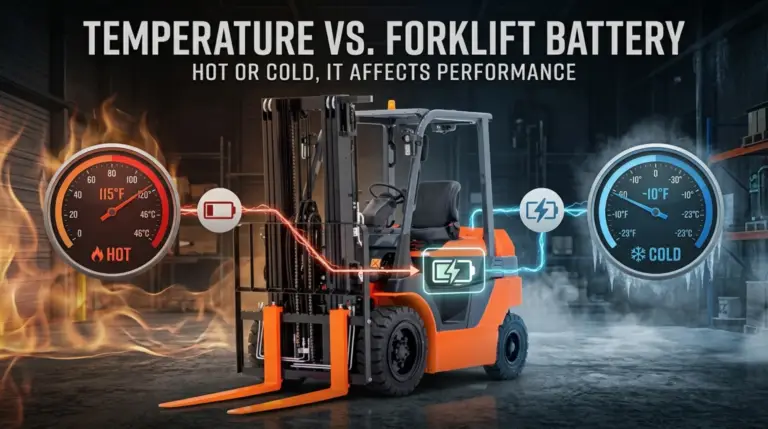
Temperature is one of the most overlooked factors in electric forklift charging. Both extreme heat and extreme cold directly impact charging efficiency and battery longevity.
Heat Is the Enemy of Battery Life
Charging a battery that is already hot from heavy use accelerates internal chemical degradation. This is why the cool-down period after charging and before operation is so important — and why a battery should also cool down slightly from heavy discharge before being connected to the charger.
The ideal charging temperature range for lead-acid batteries is 50°F to 86°F (10°C to 30°C). Charging in ambient temperatures above 90°F significantly increases water loss and shortens cell life. If your warehouse runs hot in summer months, consider scheduling charging during cooler overnight hours.
Cold Environments Reduce Capacity
If you operate in a cold storage facility or charge batteries in an unheated space during winter, be aware that low temperatures reduce battery capacity and slow charge acceptance. A battery in a 40°F environment may deliver noticeably less runtime than the same battery at 70°F.
Allow batteries to reach room temperature before initiating a charge cycle if they have been sitting in a cold environment. Charging a very cold battery forces the charger to work harder and may result in incomplete charge acceptance.
Watering Lead-Acid Forklift Batteries
This is an area where many operations fall behind, often without realizing it until damage has already occurred.
Lead-acid batteries consume water during the charging process. As the charger applies voltage during the equalization phase, water molecules in the electrolyte split into hydrogen and oxygen gas. If you do not replenish this water consistently, the battery plates become exposed to air — and that exposure causes rapid, irreversible damage.
How Often to Add Water
Check the water level after each full charge cycle, not before. Adding water before charging causes the electrolyte to expand during charging and overflow, leading to acid spills and corrosion.
Most batteries require watering every five to ten charge cycles, but this varies by battery size and usage intensity. Check your manufacturer’s specifications.
Use Only Distilled or Deionized Water
Tap water contains minerals that contaminate the electrolyte and accelerate plate corrosion. Always use distilled or deionized water when topping off battery cells.
Fill each cell to the correct level — typically just below the split ring inside the vent opening. Do not overfill. Overfilling causes electrolyte to boil out during charging, creating corrosive spills on the battery casing and surrounding equipment.
Consider an automatic watering system.
For large fleets, manual watering is labor-intensive and easy to neglect. Automatic battery watering systems attach directly to the battery and fill each cell to the correct level with a single connection. They pay for themselves quickly in reduced maintenance time and prevented battery damage.
Lithium-Ion Forklift Battery Considerations
If your fleet uses or is transitioning to lithium-ion batteries, the charging landscape changes considerably.
Key Advantages
- No watering required: Lithium-ion batteries are completely sealed
- No equalization charge needed: The battery management system (BMS) handles cell balancing automatically
- Faster charging: Many lithium-ion batteries reach full charge in 1 to 2 hours
- Opportunity charging is safe: Partial charging does not reduce capacity or cycle life
- Longer lifespan: Typically 3,000 or more cycles with proper care
What to Watch For
Despite requiring less maintenance, lithium-ion batteries are not maintenance-free. Keep these points in mind:
- Never bypass or damage the BMS: The battery management system is critical to safe operation and lifespan protection
- Use only approved chargers: Lithium-ion batteries require chargers specifically designed for their chemistry. Using an incompatible charger is a fire and safety risk
- Monitor for swelling or unusual heat: These are warning signs of cell damage that require immediate professional attention
- Follow manufacturer storage guidelines: If a lithium-ion battery will be stored for an extended period, charge it to approximately 50% first
Common Mistakes to Avoid
Even experienced operators fall into habits that quietly damage their batteries. Watch out for these frequent missteps:
- Charging too infrequently: Letting a lead-acid battery sit in a partially discharged state for extended periods causes sulfation
- Ignoring charger error codes: Modern smart chargers display fault codes. Investigate any code immediately rather than resetting and continuing
- Using the wrong charger voltage: A charger rated for a 24V battery will damage a 48V battery. Always match charger output to battery specifications
- Skipping the cool-down period: Rushing a hot battery back into service shortens its overall lifespan
- Neglecting battery records: Tracking charge cycles, water additions, and maintenance history helps you identify declining batteries before they fail mid-shift
Building a Forklift Battery Maintenance Program
Consistent results come from consistent processes. A structured battery maintenance program removes guesswork and ensures nothing falls through the cracks.
Your program should include:
- Daily: Operator inspection of battery condition, connector integrity, and discharge level at end of shift
- Per charge cycle: Check water levels after charging (lead-acid); log the charge cycle
- Weekly: Inspect charger cables and connectors; clean battery tops to remove corrosion and dust
- Monthly: Review battery performance logs; check for any cells showing reduced capacity or unusual heat
- Annually: Schedule a professional battery load test to assess overall health and identify batteries approaching end of life
Assigning clear responsibility for each task — whether to operators, a maintenance technician, or a battery service provider — ensures the program actually runs.
Conclusion
Effective electric forklift charging is not complicated, but it does require discipline and consistency. The habits your team builds around charging schedules, discharge limits, watering routines, and charging area safety determine whether your batteries last five years or two.
Here is what to focus on first:
- Establish a fixed charging schedule that aligns with your shift structure
- Never interrupt a lead-acid charge cycle and never discharge below 20%
- Set up a dedicated, well-ventilated charging area with proper safety equipment
- Create a watering schedule for lead-acid batteries and assign ownership
- Evaluate whether lithium-ion technology better fits your operational demands
A small investment in better charging practices today prevents significant capital losses tomorrow. Review your current protocols, train your operators on the fundamentals, and build the habits that keep your fleet productive, safe, and running at full capacity.