
You back up to a loaded trailer, glance at the pallet, then spin the wheel to line up your fork. That single turn tells you almost everything about whether you picked the right forklift. Cramped between racking with a machine that won’t pivot, you’ll fight the aisle all shift. Out on a gravel yard with a light-footed truck that skates on loose ground, you’ll wish you had more machine underneath you. The gap between a three-wheel and a four-wheel forklift shows up in exactly these moments, and it costs you time, money, or safety when the choice doesn’t fit the work.
The ideal forklift depends on how and where the machine will be used, not simply which model appears more capable. A three-wheel forklift is built for tight turning areas and indoor operations where maneuverability matters most, while a four-wheel forklift focuses on stability and handling heavier loads across more demanding surfaces.
Your operating environment plays a major role in determining which configuration delivers better results. Narrow warehouse aisles, frequent direction changes, smooth floors, uneven yards, load size, and travel distance all influence forklift performance. Matching the forklift design to those conditions helps improve efficiency, safety, and long-term productivity.
How Each Configuration Works
Before you choose, you need to understand what those wheels actually do for stability, turning, and lifting. Both machines carry a load and raise it high, but the way they distribute weight and pivot decides where each one is strong. That single design difference drives nearly everything else about how the forklift performs on your floor.
The wheel arrangement affects more than just movement; it influences turning radius, load balance, operator control, and how confidently the forklift handles different working conditions. Understanding these characteristics helps you see why one configuration may excel in a warehouse aisle while another performs better in open or heavier-duty environments.
Weight Distribution and the Stability Base
A four-wheel forklift plants its weight on four contact points across a wide, rectangular footprint. That broad base builds a larger stability triangle, giving the machine steadier footing when it lifts heavy loads or stacks tall. The wider the stance, the more the forklift resists the tipping forces that come with height and weight, which is why four-wheel machines handle demanding lifts with confidence.
A three-wheel forklift narrows toward the rear, riding on a single drive wheel or a close-set pair at the back. That trimmed base reduces lateral stability compared to a four-wheel machine, so three-wheel models suit lighter to moderate loads rather than the heaviest work. It’s a deliberate trade: you give up some steadiness at height in exchange for a machine built to turn in far less space.
Takeaway: A wider four-wheel base delivers greater stability and capacity, while a three-wheel base sacrifices some of that steadiness to gain a tighter, more agile turn.
Turning Radius and Maneuverability
Maneuverability is where the three-wheel design makes its name. With the rear wheel positioned centrally, a three-wheel forklift pivots almost on its own axis, cutting a dramatically tighter turning radius. In a narrow aisle, it can rotate and reposition in a single smooth motion where a four-wheel machine would need to shunt back and forth to finish the same turn.

A four-wheel forklift trades that agility for its wider, steadier stance. The four-wheel geometry produces a larger turning radius, so the machine needs more room to maneuver. In open yards and wide aisles, that’s no obstacle at all. Inside a packed warehouse, though, every extra foot of turning space is an aisle you can’t convert into racking or storage.
Where Three-Wheel Forklifts Excel
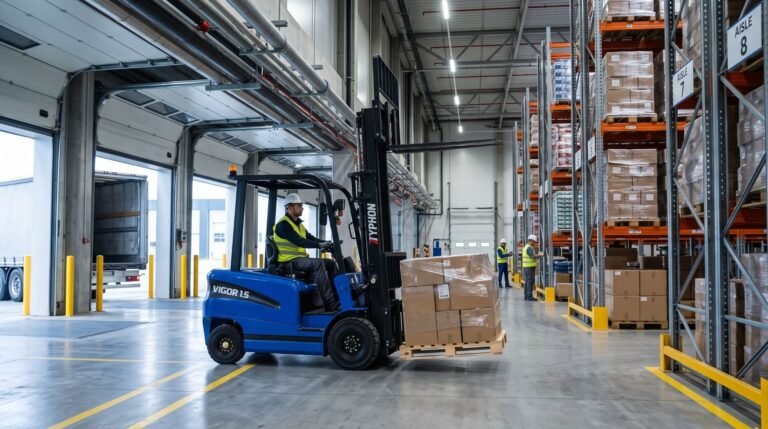
A three-wheel forklift is designed around maneuverability rather than maximum stability, making it a strong option for operations where space is limited. Its compact turning radius allows operators to navigate narrow aisles, tight corners, and confined work areas more efficiently without sacrificing everyday lifting performance.
This configuration works best in environments where smooth surfaces, frequent direction changes, and precise positioning are part of the daily routine. For warehouses and indoor facilities with limited space, a three-wheel forklift can provide the flexibility needed to keep operations moving efficiently.
Tight Aisles and Dense Storage
The clearest advantage of a three-wheel forklift is how little room it needs to turn. In a warehouse where aisle width directly limits how much you can store, a machine that pivots in a tighter radius lets you narrow those aisles and pack in more racking. That reclaimed space can translate into real storage capacity without adding a single square foot to the building.
The agility speeds up the work itself, too. Operators reposition faster, complete tight turns without a three-point shuffle, and thread through dense racking with less effort. For high-volume picking and putaway in confined layouts, that responsiveness keeps cycle times short and throughput steady from the start of a shift to the end of it.
Takeaway: When your floor space is the constraint, a three-wheel forklift’s tight turning radius turns cramped aisles into usable storage and faster cycles.
Indoor Work on Smooth Floors
Three-wheel forklifts are typically electric and built for the clean, level floors of indoor facilities. On smooth concrete, their lighter footprint and precise handling shine, and running electric indoors means zero emissions and quieter operation, both of which matter in enclosed spaces where crews work side by side all day. For warehousing, distribution, and light manufacturing, that fit is hard to beat.
Those strengths hold as long as the surface stays firm and even. Smooth floors play directly to a three-wheel machine’s handling, letting it deliver consistent, controlled performance load after load. Keep it on the ground it’s designed for, and a three-wheel forklift proves itself a dependable, productive workhorse that earns its place in the building.
Where Four-Wheel Forklifts Win
A four-wheel forklift is built for applications where stability, load capacity, and traction become the main priorities. Its wider stance provides better balance when handling heavier materials, traveling longer distances, or operating on uneven surfaces where extra support is needed.
This design is well suited for outdoor yards, construction areas, and demanding material handling environments. When the job involves larger loads or more challenging ground conditions, a four-wheel forklift provides the control and confidence needed to move materials safely and efficiently.
Rough Terrain and Outdoor Ground
Outdoor work punishes a machine built for smooth floors. Gravel lots, uneven pavement, loading docks, and sloped yards demand traction and ground clearance that a four-wheel forklift provides far better than a three-wheel one. With four contact points and a more rugged drivetrain, it stays planted where a lighter machine would slip, skate, or struggle for grip.
Many four-wheel models run on internal combustion engines with pneumatic tires suited to rough ground, giving them the power and durability outdoor operations depend on. For lumberyards, construction sites, and busy outdoor loading areas, that ruggedness keeps material moving in conditions that would sideline an indoor machine before lunch.

Heavy Loads and High Stacking
When capacity is the priority, the four-wheel design leads without much argument. Its broad, stable base handles heavier pallets and holds steady as the mast climbs, so you can lift more and stack higher with confidence. For operations routinely moving dense or bulky loads, that headroom in capacity is essential rather than a nice-to-have.
Stability at height matters as much as raw lifting power. Raising a heavy load high shifts the machine’s center of gravity, and a four-wheel forklift’s wider footprint keeps it secure through that lift. When your racking runs tall or your loads run heavy, that steadiness protects the load, the racking, and the operator all at once.
Takeaway: For rough ground, heavy loads, and tall stacking, a four-wheel forklift’s wider base and rugged build deliver the traction and stability those demands require.
Buying and Renting Considerations
After identifying the forklift configuration that matches your operation, several practical details can influence the final decision. Beyond wheel count, factors such as load capacity, operating environment, maintenance needs, and daily usage patterns determine whether the machine will deliver long-term value.
Taking time to evaluate these requirements before buying or renting helps prevent mismatched equipment and unnecessary costs. A forklift that fits the workload from the start will provide better performance, reliability, and return throughout its service life.
Total Cost, Power Source, and Support
Look past the sticker price to what the machine costs to run. Three-wheel forklifts are commonly electric, which means lower fuel costs, fewer moving parts, and cleaner, quieter indoor operation, though you’ll plan around charging and battery care. Four-wheel machines often run on internal combustion for outdoor power, trading higher fuel and maintenance costs for the ruggedness those conditions require.
Support and parts availability belong in the same conversation. Downtime on a forklift can stall an entire operation, so confirm that service, replacement parts, and technical help are readily available for the machine you choose. A dependable machine backed by responsive support protects your productivity far more than a lower purchase price ever will.
When Renting Makes Sense
Renting is worth serious thought when your need is temporary or seasonal. A short-term project, a demand spike, or an occasional outdoor task that falls outside your usual work can be covered with a rental rather than a second machine sitting idle most of the year. That flexibility keeps your capital free and matches the equipment to the actual workload in front of you.
Renting also lets you test a configuration before committing. If you’re weighing whether a three-wheel machine’s agility or a four-wheel machine’s stability better fits your operation, a rental puts real hours on the machine before you buy. Use that trial to confirm the fit, then invest in the configuration your work proves it needs.
Takeaway: Weigh total cost, power source, maintenance, and support alongside the buy-versus-rent question, and you’ll land on a forklift that fits both your work and your budget for the long haul.
Conclusion
Three-wheel and four-wheel forklifts are designed around different operating priorities. Three-wheel models focus on maneuverability, making them effective for narrow warehouse aisles, frequent turns, and indoor applications where space efficiency matters. Four-wheel forklifts are built for greater stability, traction, and load control, giving them an advantage when handling heavier materials, uneven surfaces, or outdoor work environments.
A productive forklift fleet starts with matching the machine to the conditions it will face every day. Evaluating aisle width, floor conditions, travel distance, load size, and lifting requirements helps prevent choosing a forklift that is either oversized for the job or pushed beyond its limits. The right configuration allows operators to move materials with better control, efficiency, and confidence throughout the operation.
Frequently Asked Questions
Can three-wheel and four-wheel forklifts use the same attachments?
Most standard attachments work with both types, but capacity and stability can change after installation. Always check the forklift’s rated capacity with the attachment fitted.
Are three-wheel and four-wheel forklifts operated the same way?
Basic forklift training applies to both, but each configuration is handled differently. Operators should understand the turning response, balance, and load behavior of the specific model they use.
Which forklift type handles attachments better?
Both can handle a wide range of attachments, but four-wheel forklifts generally provide more stability for heavier attachments and larger loads.