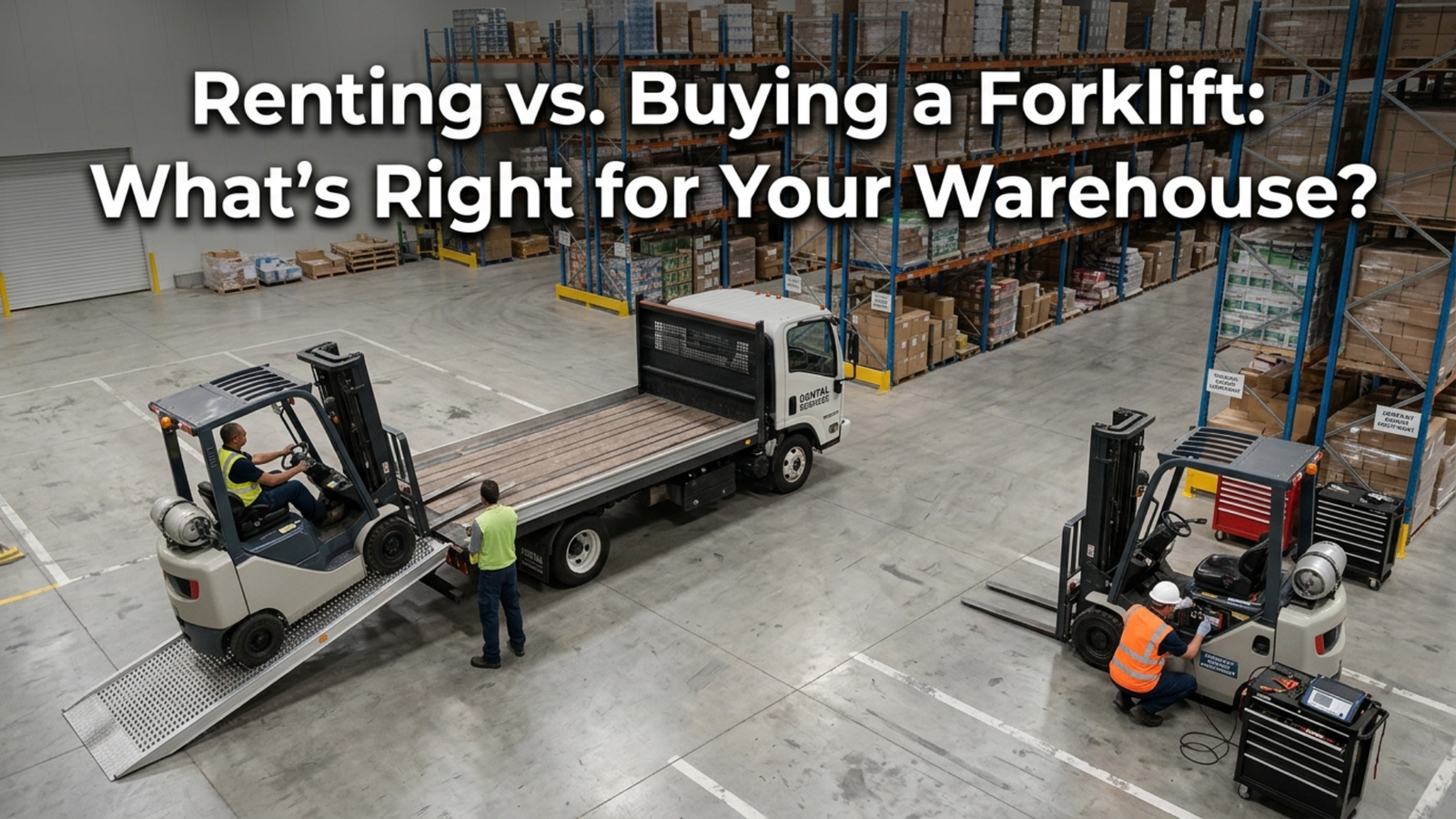
Few equipment decisions shape your warehouse budget quite like choosing whether to rent or buy a forklift. Get it right, and you match your spending to your actual workload while keeping operations running smoothly. Get it wrong, and you either overpay for a machine that sits idle or scramble for equipment when demand spikes. The good news is that this is a decision you can make with confidence once you understand the trade-offs involved. Renting and buying each carry real advantages, and the smartest choice depends on how your warehouse actually operates. This guide walks you through the key differences, the situations where each option shines, the full range of costs to weigh, and the practical factors that point you toward the right answer for your business.
Renting vs. Buying: What’s the Difference?
At its core, the choice between renting and buying comes down to ownership. When you buy a forklift, the machine becomes a permanent asset on your books. You own it outright or finance it over time, and it stays in your fleet for as long as it serves you. When you rent, you pay for temporary access to a machine that belongs to the rental provider, using it for the term you need and returning it when the job is done. That single distinction ripples out into nearly every other consideration, from cost structure to daily responsibility.
Flexibility is where the two paths diverge most clearly. Renting gives you the freedom to scale your equipment up or down as your needs change, without committing capital to a machine you may not always require. Buying trades that flexibility for stability, giving you a dependable machine that is always on hand and fully under your control.
The differences show up across several practical areas:
- Ownership: Buying makes the forklift your asset; renting keeps it the provider’s property.
- Upfront cost: Buying requires a large initial investment or financing; renting spreads cost into predictable payments.
- Maintenance responsibility: Owners handle service and repairs; rental agreements often include maintenance.
- Commitment: Buying is a long-term decision; renting adapts to short or changing timelines.
Understanding these distinctions is the foundation for everything that follows. Neither option is universally better. A high-volume distribution center and a contractor handling a three-week project face very different realities, and the right answer for each grows directly out of how ownership, flexibility, and responsibility align with their operations. Knowing what separates the two lets you weigh them against your own warehouse honestly.
When Renting a Forklift Makes More Sense
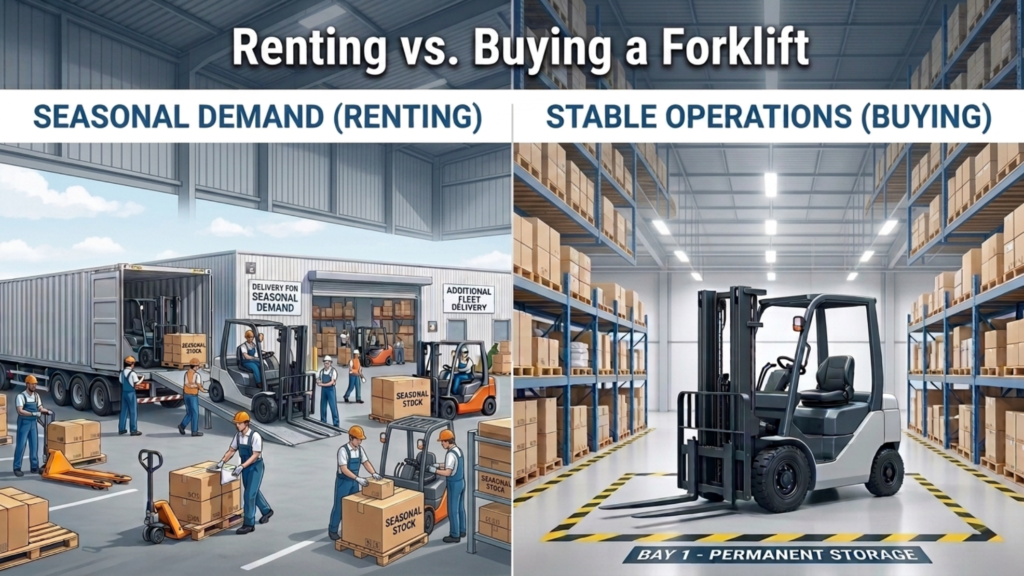
Renting is often the smarter move when your need for a forklift is temporary or unpredictable. If you take on a short-term project with a clear end date, buying a machine rarely makes financial sense. You would tie up capital in equipment that becomes idle the moment the job wraps up. Renting lets you bring in exactly the forklift you need for exactly as long as you need it, then hand it back without the burden of storage, resale, or long-term upkeep. That clean, defined arrangement fits project-based work perfectly.
Seasonal demand is another situation where renting shines. Many warehouses see their workload swell during peak periods, whether that is a holiday rush, a harvest window, or a busy shipping season, then quiet down for the rest of the year. Buying enough forklifts to cover your busiest weeks means paying year-round for machines that sit unused during slow stretches. Renting extra units only when volume climbs keeps your fleet lean and your spending tied directly to actual activity.
Renting also protects your cash flow by eliminating the large upfront cost of ownership. This matters especially for growing businesses and operations that would rather preserve capital for other priorities. Consider when renting tends to be the better call:
- Short-term projects with a defined completion date
- Seasonal spikes that require temporary extra capacity
- Specialized tasks that need a machine you rarely use otherwise
- Tight budgets where avoiding a major purchase preserves working capital
- Testing needs before committing to a specific forklift model
In each of these cases, renting delivers the equipment you need while sparing you the financial weight and responsibility of ownership. When your requirements are temporary, variable, or uncertain, renting gives you the reliability of a capable machine without locking you into a long-term commitment.
When Buying a Forklift Is the Better Investment
Buying becomes the wiser choice when your warehouse relies on a forklift day in and day out. For operations with consistent, long-term material handling needs, ownership almost always delivers better value over time. When a machine works full shifts throughout the year, the cumulative cost of renting it climbs steadily, and at a certain point those payments would have covered the purchase price several times over. If you know you will need a forklift for years to come, buying turns a recurring expense into a lasting asset.
The return on investment strengthens the case further. A purchased forklift, well maintained, serves your warehouse for many years, and once financing is paid off, your cost per operating hour drops sharply. That long service life spreads the initial investment across thousands of productive hours, making each shift more economical than a rental would be. Ownership also lets you tailor the machine to your exact needs, choosing the specifications, attachments, and configuration that fit your operation rather than settling for whatever a rental fleet has available.
Beyond the numbers, ownership brings practical advantages that support steady operations:
- Constant availability: The machine is always on-site and ready, with no rental scheduling or return deadlines.
- Full control: You set the maintenance schedule and keep the forklift in the condition your work demands.
- Customization: You equip the machine with the attachments and features your tasks require.
- Asset value: The forklift retains resale value you can recover when you eventually upgrade.
For a warehouse with predictable, ongoing demand, these benefits add up to dependable performance and lower long-term costs. When a forklift is central to your daily workflow rather than an occasional need, buying gives you the reliability, control, and economic efficiency that ownership is built to provide.
Key Costs to Consider Before Deciding
The sticker price of a forklift tells only part of the story, and a sound decision depends on comparing the full cost of each option. Renting bundles many expenses into a single, predictable payment, while buying spreads a range of costs across the life of the machine. Looking past the initial figure to the total cost of ownership is what reveals which path truly serves your budget, so take the time to account for every expense each option carries.
Maintenance and repairs are among the largest ongoing considerations. When you own a forklift, you shoulder the full cost of routine servicing, replacement parts, and unexpected breakdowns, which grows as the machine ages. Rental agreements frequently fold maintenance into the rate, sparing you those bills and the downtime that comes with arranging repairs. Financing and insurance add further weight to the ownership column. A purchased machine often involves loan interest, and you must insure the equipment you own, whereas rental costs are typically more contained and straightforward.
Depreciation is the cost owners most often overlook. A forklift loses value the moment it enters service, and that decline continues throughout its life, affecting what you can recover at resale. Renters avoid depreciation entirely, since the machine never appears on their books. When weighing the two, factor in the complete picture:
- Maintenance and repairs: Owner-paid and rising over time versus often included in rental rates
- Financing: Loan interest for buyers versus predictable rental payments
- Insurance: Required for owned equipment versus limited exposure when renting
- Depreciation: A real loss for owners versus a non-issue for renters
Comparing these costs side by side, rather than fixating on purchase price alone, gives you an honest view of what each option demands. That clarity is what protects your budget and guides you toward the financially sound choice.
How to Choose the Right Option for Your Warehouse
With the differences and costs in view, the decision comes down to matching the option to how your warehouse actually runs. There is no single correct answer, only the choice that best fits your budget, your workload, and your plans for the future. The most reliable way to decide is to evaluate your operation honestly against a few key factors, letting your real circumstances point you toward renting or buying rather than a general rule of thumb.
Start with usage frequency and budget, since these two factors carry the most weight. A forklift running long hours nearly every day builds a strong case for buying, while one needed only occasionally or seasonally favors renting. Your budget shapes the picture just as much. If preserving capital matters more than owning an asset right now, renting keeps cash available for other priorities, whereas a business ready to invest in a long-term asset may find ownership the sounder move.
Business growth and operational requirements round out the assessment. A rapidly changing or expanding operation benefits from the flexibility renting provides, while a stable warehouse with predictable needs is better suited to the reliability of ownership. Work through these questions before you commit:
- How often will the forklift run? Daily, full-shift use points to buying; occasional use points to renting.
- What does your budget allow? Preserving capital favors renting; investing in an asset favors buying.
- Where is your business headed? Uncertain or fast growth favors flexibility; steady demand favors ownership.
- What do your tasks require? Specialized or changing needs may suit renting; consistent needs suit buying.
Weighing these factors together gives you a clear, grounded answer tailored to your warehouse. When you match the option to your genuine operational reality, you make a confident decision that supports both your productivity and your bottom line.
Conclusion
Choosing between renting and buying a forklift is ultimately about aligning your equipment with the way your warehouse works. Renting delivers flexibility and protects your cash flow, making it ideal for short-term projects, seasonal demand, and operations that value adaptability. Buying delivers long-term value, full control, and lower cost per hour for warehouses with steady, ongoing needs. The right choice depends on your usage patterns, your budget, your growth plans, and the true total cost of each option rather than the purchase price alone. Take an honest look at how often you will use the machine and where your business is heading, then let those realities guide your decision. Weigh the factors carefully, and you will land on the option that keeps your operation productive, efficient, and ready for whatever comes next.
Frequently Asked Questions
Q: What happens if a rented forklift breaks down during my project?
Renting machinery has the practical advantage that the rental provider assumes responsibility for maintenance and repairs. Most agreements feature a maintenance clause, ensuring any breakdowns are promptly addressed, which contrasts with ownership where costs and delays fall solely on the owner. It’s important to carefully review the rental terms regarding breakdown coverage, response times, and replacement provisions to safeguard project timelines and mitigate uncertainties during high-demand periods.
Q: Can I switch from renting to buying if my business grows?
Yes, and many warehouse operations follow exactly that path. Renting is a practical starting point when your volume is uncertain or your budget is limited, and it gives you time to evaluate which forklift type and capacity genuinely fits your workflow before committing to a purchase. As your business stabilizes and your daily forklift use becomes consistent, buying starts to make stronger financial sense. The transition is straightforward: review your rental history to confirm sustained usage, identify the specifications that have served you well, and work with a trusted dealer to find the right machine for your operation going forward.
Q: Is it cheaper to rent or buy a forklift in the long run?
The answer depends on how frequently and how long you plan to use the machine. Renting costs more per hour than owning over an extended period, but it eliminates large upfront investments, maintenance bills, insurance, and depreciation. If your forklift runs full shifts every day for years, buying almost always delivers a lower total cost over time. If usage is seasonal, project-based, or uncertain, renting keeps your costs tied directly to actual activity, which can make it the more economical choice even if the daily rate looks higher on paper.