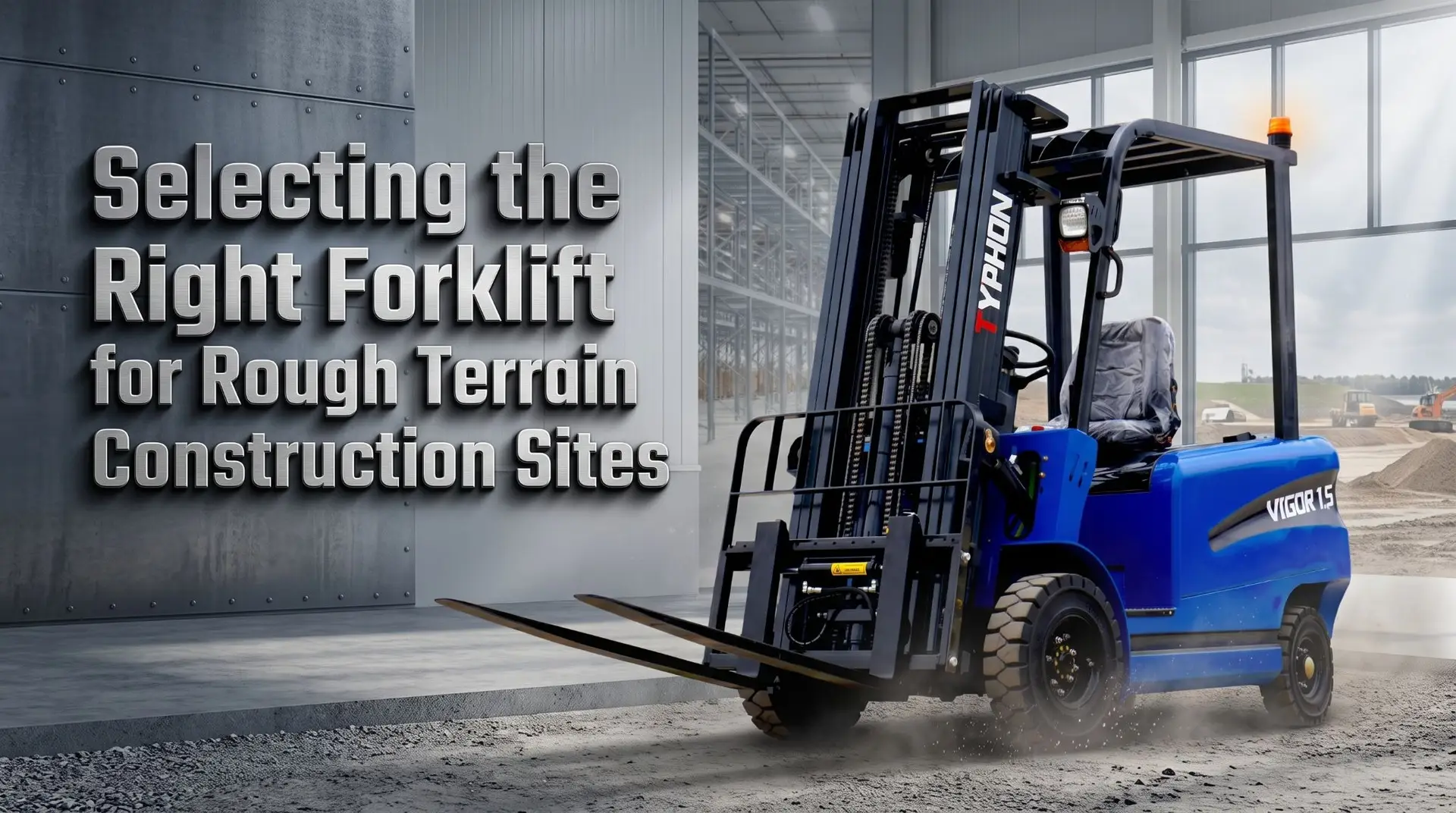
Choosing the right rough-terrain forklift shapes how smoothly your entire site runs, because the machine you pick has to perform on ground that punishes equipment built for smooth warehouse floors. A construction site throws everything at a forklift, from churned mud and loose gravel to steep ramps and tight corners crowded with material stacks, and the wrong choice shows up fast as bogged-down tires, stalled engines, and frustrated crews losing hours they cannot get back. The right machine, on the other hand, moves heavy loads confidently across unstable surfaces, climbs grades without hesitation, and keeps your operators safe and productive through long, demanding shifts.
Making a smart selection means looking past the price tag and the spec sheet headline to understand how each feature performs under real job site conditions. You need to weigh how the machine handles traction, power, lifting reach, maneuverability, and operator comfort together, since a forklift that excels in one area but falls short in another will still hold your project back.
The five sections below walk you through the factors that matter most when evaluating equipment for challenging terrain, giving you a practical framework you can apply whether you are buying, renting, or simply matching the right unit to the next phase of work. By understanding what to look for in each area, you protect your investment, keep your crew safe, and ensure the forklift you bring to site can actually handle the conditions waiting for it rather than becoming another piece of equipment that struggles when the ground gets rough.
Tire Type and Traction Capabilities
Tires are where a rough terrain forklift meets the ground, and they often make the difference between a machine that works confidently and one that spins helplessly in the mud. Standard cushion tires built for warehouse floors have no place on a construction site, because they lack the depth and structure needed to bite into loose, uneven, or saturated surfaces. Instead, rough-terrain machines rely on specialized options designed to maintain grip and stability under load, and understanding these choices helps you match the tire to your specific conditions.
Deep-tread pneumatic tires deliver excellent traction across mud, gravel, and soft soil, using their aggressive tread pattern to dig in and channel away material that would otherwise rob the machine of grip. They also cushion the ride, absorbing shock from rocks and ruts that would otherwise jolt the operator and the load. Foam-filled tires take a different approach, eliminating the risk of punctures by replacing air with a solid fill, which matters enormously on sites littered with nails, rebar, and sharp debris that flatten conventional tires and stop work cold. The trade-off is a firmer ride and added weight, though that weight can actually improve stability when handling heavy loads.
When evaluating traction capabilities, think carefully about the surfaces your crew works on most and the hazards present underfoot, because the cost of the wrong tire shows up as lost productivity and recurring downtime. Consider these factors when comparing tire options:
- Surface conditions you face most often, whether deep mud, loose gravel, or rocky fill
- Puncture risk from debris, which pushes the decision toward foam-filled designs
- Load weight and stability needs, since heavier tires lower the center of gravity
Selecting the right tire type prevents the machine from becoming bogged down, protects against costly flats, and keeps the forklift stable and dependable when it matters most.
Engine Power and Gradeability
Construction sites rarely offer flat, predictable ground, and the slopes, ramps, and elevation changes that define them place serious demands on a forklift’s engine. Gradeability, which describes the steepness of incline a machine can climb while carrying a load, is one of the most important and most overlooked specifications when selecting equipment for rough terrain. A forklift that handles a level yard with ease can stall, slip, or lose momentum halfway up a muddy ramp if it lacks the torque and horsepower to pull a full load against gravity. That kind of failure is not just inconvenient; it creates real danger, because a machine that stalls on an incline with a raised load risks rollback, tipping, and serious injury to anyone nearby.
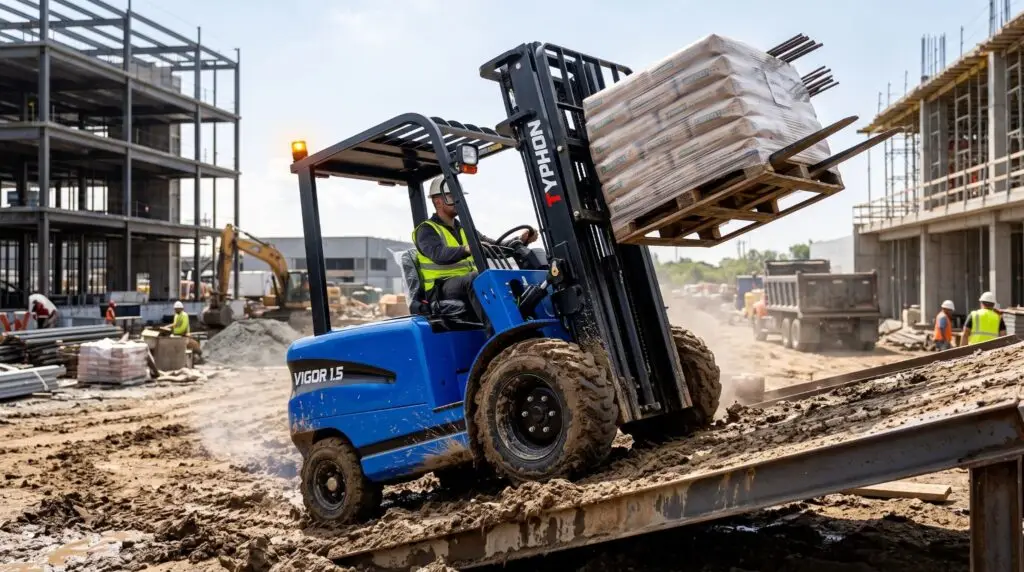
When you evaluate engine power, you need to look beyond peak horsepower numbers and pay close attention to torque, since torque is what actually moves heavy loads up a grade without bogging down. Diesel engines dominate this category for good reason, delivering the low-end pulling power and durability that demanding sites require, and they handle sustained heavy work better than smaller alternatives.
You should match the machine’s gradeability rating to the steepest slopes on your site, then build in a margin of safety rather than choosing a model that just barely meets the requirement on paper. Conditions change throughout a project, ramps grow muddier as the weather turns, and a forklift operating near its limit leaves no room for error. Choosing a model with robust gradeability and ample torque ensures the machine can safely transport materials up ramps and across uneven elevations without losing momentum or risking an engine stall, keeping both your schedule and your crew protected through every phase of the work.
Mast Height and Lift Capacity
Matching a forklift’s lifting specifications to the actual demands of your project is essential, because a mismatch in either direction creates problems that ripple across the whole site. The two figures that matter most are maximum lift height and load capacity, and you must align both with the specific vertical and weight requirements of the work in front of you. Lift height determines how high the machine can raise a load, and on a construction site this needs to account for the tallest points you must reach, whether that means stacking materials on upper levels, feeding scaffolding, or placing components at the top of a rising structure. Choosing a mast that falls short leaves you unable to complete tasks the machine was supposed to handle, forcing awkward workarounds or a second piece of equipment you should not have needed.
Load capacity, meanwhile, defines how much weight the forklift can safely lift, and this is where careful attention pays off because capacity is not a fixed number. As you raise a load higher or extend it forward, the safe capacity drops, a relationship captured in the machine’s load chart that every operator and manager should understand thoroughly. Overloading a forklift, especially at height, is one of the most dangerous mistakes on any site, inviting tip-overs, dropped loads, and structural strain on the machine itself.
When you assess these specifications, study the load chart carefully rather than relying on the headline capacity figure, and confirm the machine can handle your heaviest loads at the heights you actually need to reach. Aligning mast height and lift capacity with your real requirements prevents the risk of overloading while ensuring the forklift can reach the highest points of your structural or material staging areas safely and reliably.
Maneuverability and Turning Radius
Even across open, rugged ground, the practical working space on a construction site is often surprisingly tight, hemmed in by stacks of materials, temporary structures, trenches, and the constant movement of other machinery and crews. A forklift that performs beautifully on paper can become a liability if it cannot navigate these congested layouts, which is why maneuverability deserves serious attention when you evaluate equipment for challenging job sites. Turning radius is the key measure here, describing how tightly the machine can pivot and reposition within a confined area, and a forklift with a tight turning radius lets operators thread through narrow gaps, work close to obstacles, and reposition loads without the constant back-and-forth shuffling that wastes time and raises the risk of collisions.
Ground clearance works hand in hand with turning ability, because a machine that can pivot tightly but drags its undercarriage across rocks, ruts, and debris will hang up, lose traction, and risk damage to vital components. High ground clearance keeps the forklift moving over obstacles that would stop a lower-slung machine, preserving both mobility and stability on broken terrain.
The challenge is balancing these qualities against the load handling demands of the work, since a highly maneuverable machine must still maintain its footing when carrying heavy loads through tight spaces. The best choice depends on how crowded your site is and how often operators must work in confined areas. A forklift that combines a tight turning radius with generous ground clearance allows operators to navigate congested site layouts effectively, position loads precisely where they are needed, and keep work flowing without sacrificing the stability that safe operation on rough terrain absolutely requires throughout every shift.
Operator Ergonomics and Visibility
The person behind the controls has an enormous influence on how safely and productively a rough terrain forklift performs, and the design of the operator environment directly shapes their effectiveness through a long, physically demanding shift. Working on uneven ground is exhausting, subjecting operators to constant jolts, vibration, and the mental strain of maintaining awareness in a hazardous, ever-changing environment. A machine that ignores operator comfort and visibility wears its operator down quickly, and a tired operator makes slower decisions, places loads less accurately, and grows far more likely to miss the hazard that leads to an accident.
Prioritizing ergonomics is therefore not a luxury; it is a practical investment in safety, accuracy, and sustained output. Suspension seats are one of the most valuable features in this regard, absorbing the relentless shock of rough terrain so the operator arrives at the end of the shift far less fatigued than they would in a rigid seat. Intuitive, well-placed controls reduce the physical and mental effort of operating the machine, letting operators focus on the work and their surroundings rather than wrestling with awkward levers. Visibility matters just as much, because clear sightlines in every direction let operators spot ground workers, obstacles, and load positions accurately, preventing the blind-spot incidents that cause some of the most serious injuries on site.
When you evaluate a machine, look closely at the following:
- Suspension seating that cushions vibration and reduces operator fatigue over long shifts
- Intuitive control layout that minimizes effort and the chance of operator error
- Clear sightlines around the mast, load, and travel path to spot hazards early
Choosing a forklift built around the operator helps reduce fatigue, sharpens situational awareness, and improves the accuracy of every load placement throughout the working day.
Conclusion
Selecting the right rough terrain forklift comes down to evaluating how a machine will truly perform under the specific conditions your site presents, rather than settling for the first unit that fits the budget. The five factors covered here work together, and a strong forklift balances all of them: tires that grip and resist punctures, an engine with the torque and gradeability to climb loaded ramps, a mast and capacity matched to your real lifting needs, the maneuverability to work tight spaces with confidence, and an operator environment that keeps your crew sharp and safe through long shifts. Weakness in any one area undermines the others and holds your whole project back.
Start by assessing the toughest conditions on your site, then compare each machine’s specifications against those demands with a margin of safety built in. Take the time to make a careful, informed choice, and you will gain a dependable machine that protects your crew, keeps materials moving, and helps your project stay on schedule.