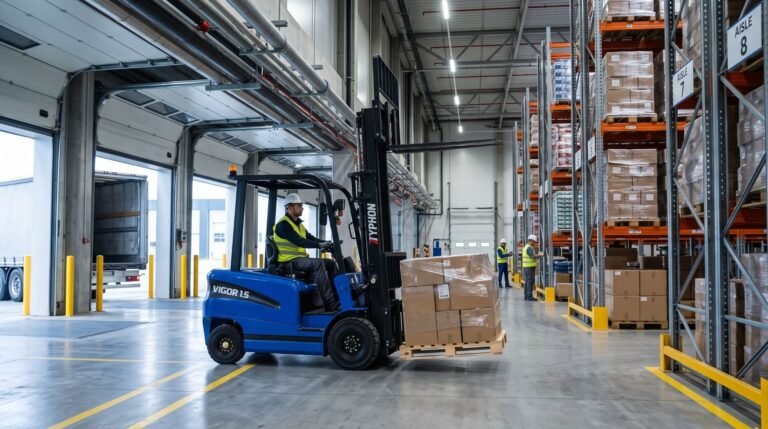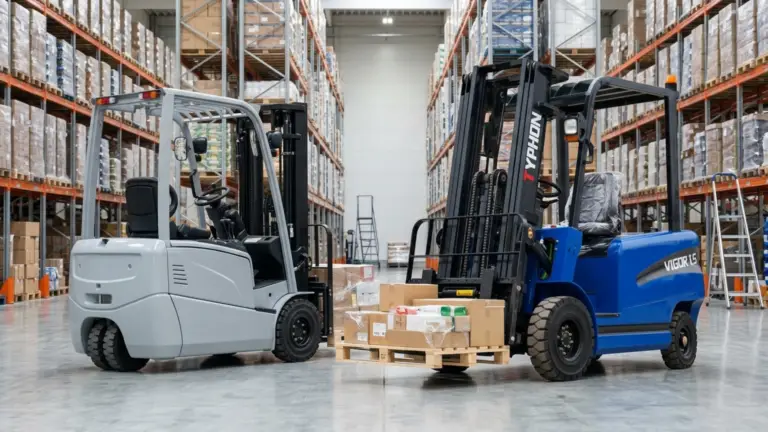


The battery inside your forklift shapes far more than how long the machine runs between charges. It affects your labor costs, your warehouse layout, your safety practices, and the productivity of every shift you run. For decades, material handling operations built their routines around the strengths and limitations of lead-acid power, accepting the maintenance, the swapping, and the dedicated charging rooms as simply part of the job. Then lithium-ion arrived and changed the calculation entirely. Understanding how forklift battery technology evolved helps you see why modern operations look so different from those of a generation ago, and why the choice of power source deserves serious attention. This guide traces that journey from traditional lead-acid batteries through the rise of opportunity charging and into the lithium-ion era, explaining what each stage meant for warehouses and what the shift means for the way facilities operate today.
The Era of Traditional Lead-Acid Batteries

For decades, lead-acid batteries served as the undisputed standard in the material handling world, and for good reason. They delivered dependable power at a reasonable upfront cost, and operations everywhere built their workflows around them. That reliability came with a significant catch, though. Lead-acid batteries demand steady, hands-on maintenance to perform as intended. Operators had to check and refill water levels regularly, monitor the cells, and follow careful charging routines to protect the battery’s life. Skipping this upkeep shortened the battery’s usable life and eroded performance, so the maintenance was never optional.
The charging process brought its own set of demands. Lead-acid batteries release gases while charging, which meant facilities had to set aside dedicated, well-ventilated charging rooms to keep the workspace safe. These rooms consumed valuable floor space and required specialized equipment to manage properly. On top of that, the batteries lose efficiency as they discharge, delivering weaker performance toward the end of a cycle rather than steady power throughout.
That fading performance created one of the biggest operational headaches of the era: battery swapping. Because a single charge often could not carry a forklift through a full shift at peak output, operations running long or multiple shifts had to swap batteries partway through the day. Each swap took time, required lifting heavy batteries with dedicated equipment, and pulled the machine and operator away from productive work. Warehouses kept spare batteries on hand and rotated them through charging cycles, tying up money, space, and labor. Lead-acid power worked, but it kept operations tethered to a demanding routine.
The Rise of Opportunity Charging
As warehouses pushed for greater productivity, the rigid charging schedules of traditional lead-acid batteries became a growing frustration. The old approach required a full, uninterrupted charge followed by a cooldown period before a battery could return to work, which locked operations into fixed cycles and forced the battery swapping that ate into shift time. Advances in charging technology offered a smarter way forward. Opportunity charging allowed operators to plug in during the natural breaks that already occurred throughout the day, topping off the battery during lunch, shift changes, or brief pauses in the workflow.
This shift made a real difference in day-to-day productivity. Instead of pulling a forklift out of service to swap in a fresh battery, operators could keep the same battery working by grabbing short charges whenever the opportunity arose. The approach reduced downtime, cut back on the number of spare batteries a facility needed, and eased some of the labor tied to constant swapping. For many warehouses, opportunity charging was a meaningful step toward the flexible, continuous operation that modern logistics demands.
Even so, opportunity charging did not solve every problem. It made lead-acid batteries more convenient to use, but it did not change the underlying chemistry. Operations still faced the watering, the equalizing charges, and the ventilated charging areas that traditional batteries required. Frequent opportunity charging could also add stress to lead-acid cells if not managed carefully, affecting their long-term life. So while this technology helped warehouses maintain productivity and loosened the grip of rigid charging schedules, it left facilities tied to the maintenance realities of traditional battery chemistry. The industry had improved the routine, but it had not yet replaced it.
The Lithium-Ion Transition

Lithium-ion technology marked a genuine turning point for the material handling industry, addressing the very limitations that had defined the lead-acid era. The most immediate change was maintenance, or rather the near absence of it. Lithium-ion batteries are virtually maintenance-free, eliminating the watering, equalizing, and careful cell monitoring that consumed so much time with traditional batteries. Operators no longer had to schedule regular upkeep or worry that a missed watering would shorten a battery’s life. This alone freed up labor and removed a persistent source of human error from daily operations.
The benefits extended to the charging environment as well. Because lithium-ion batteries do not release the gases that lead-acid batteries produce during charging, they do not require the dedicated, well-ventilated charging rooms that facilities once had to build and maintain. Batteries can charge safely right where the forklifts work, which simplifies the entire setup and removes a layer of specialized infrastructure. For facility managers, that means fewer safety concerns tied to charging and a cleaner, more straightforward operation.
The performance told an equally compelling story. Lead-acid batteries fade as they discharge, delivering strong power early and weaker power as the charge drops. Lithium-ion batteries behave very differently, maintaining a consistent voltage throughout the discharge cycle. A forklift running on lithium-ion power performs at full strength whether the battery is nearly full or approaching the end of its charge, so operators get dependable, steady output all shift long. This consistency removes the mid-shift slowdown that lead-acid users simply learned to expect. Taken together, the freedom from maintenance, the elimination of dedicated charging rooms, and the steady performance made lithium-ion a transformative upgrade rather than a small refinement.
Benefits of Faster Charging and Longer Life
Two of lithium-ion’s most valuable advantages become clear once a battery is in daily service: how quickly it charges and how long it lasts. Lithium-ion batteries accept a charge far faster than lead-acid batteries can, often reaching a full charge in under two hours. That speed transforms how operations manage their power. Rather than planning shifts around lengthy charging cycles or maintaining a fleet of spare batteries, a warehouse can keep forklifts running with quick charges during natural breaks, confident that a battery will be ready when it is needed.
This fast charging pairs naturally with the opportunity charging approach, but without the drawbacks that came with lead-acid chemistry. A quick top-off during a break restores meaningful runtime, and the battery handles these frequent partial charges without the stress that would wear down a traditional battery. The result is continuous productivity with far less downtime, which is exactly what high-intensity and multi-shift operations require to hit their targets.
The advantages reach well beyond a single shift. Consider what lithium-ion delivers over the life of the battery:
- Faster charging that returns forklifts to work in under two hours
- Longer cycle life that lets the battery endure many more charge cycles before replacement
- Lower total cost of ownership that offsets the higher upfront investment over time
- Reliable performance in demanding, multi-shift environments
That longer cycle life is a key part of the value equation. While lithium-ion batteries cost more to purchase initially, they last significantly longer than lead-acid batteries, spreading their cost across far more working hours. When you factor in the reduced maintenance, the labor savings, and the eliminated need for spare batteries, the lower total cost of ownership makes lithium-ion a sound investment for operations that run hard and run often.
Future Impacts on Warehouse Efficiency
The shift to lithium-ion power is doing more than upgrading individual forklifts; it is reshaping how entire warehouses are designed and run. One of the clearest effects shows up in floor space. Lead-acid batteries required sprawling battery rooms, ventilation systems, and dedicated areas for storing and swapping spares. Lithium-ion removes that need entirely. Because these batteries charge safely on the warehouse floor without special ventilation, facilities can reclaim the space once given over to battery management and put it toward storage, staging, or additional workflow capacity.
That reclaimed space enables more compact, efficient layouts that were not practical under the old model. Warehouse designers can plan around the actual movement of goods rather than working around the infrastructure that lead-acid batteries demanded. In an industry where every square foot carries a cost, freeing up that room delivers real value and gives operations more flexibility in how they organize their facilities. Combined with the reduced downtime that fast charging provides, the space savings help warehouses do more within the same footprint.
The broader impact touches the rhythm of daily operations. By minimizing downtime and removing the labor tied to battery maintenance and swapping, lithium-ion power lets facilities keep forklifts moving and workers focused on productive tasks. Operations can run longer and harder without the interruptions that once defined shift planning. As adoption continues to spread across the logistics sector, these gains are becoming the new baseline rather than a competitive edge. Modern facilities are being built and managed with lithium-ion power in mind, and the technology is fundamentally changing how logistics operations approach efficiency, space, and productivity every single day.
Conclusion
The journey from lead-acid to lithium-ion tells a clear story of an industry steadily solving its own hardest problems. Lead-acid batteries kept warehouses running for decades, but they demanded constant maintenance, dedicated charging rooms, and disruptive battery swaps that cost time and money. Opportunity charging eased the rigidity of old charging schedules, yet it left operations tied to the same underlying chemistry. Lithium-ion changed everything by delivering a virtually maintenance-free power source with consistent voltage, fast charging, a longer cycle life, and a lower total cost of ownership. Beyond the batteries themselves, the technology is reshaping warehouse layouts and daily operations, freeing up valuable space and minimizing the downtime that once dictated how shifts were planned. For any operation weighing its power options, understanding this evolution makes the path forward clear. Choosing the right battery technology is a decision that affects productivity, cost, and efficiency for years to come, and lithium-ion has firmly established itself as the standard modern operations are built around.