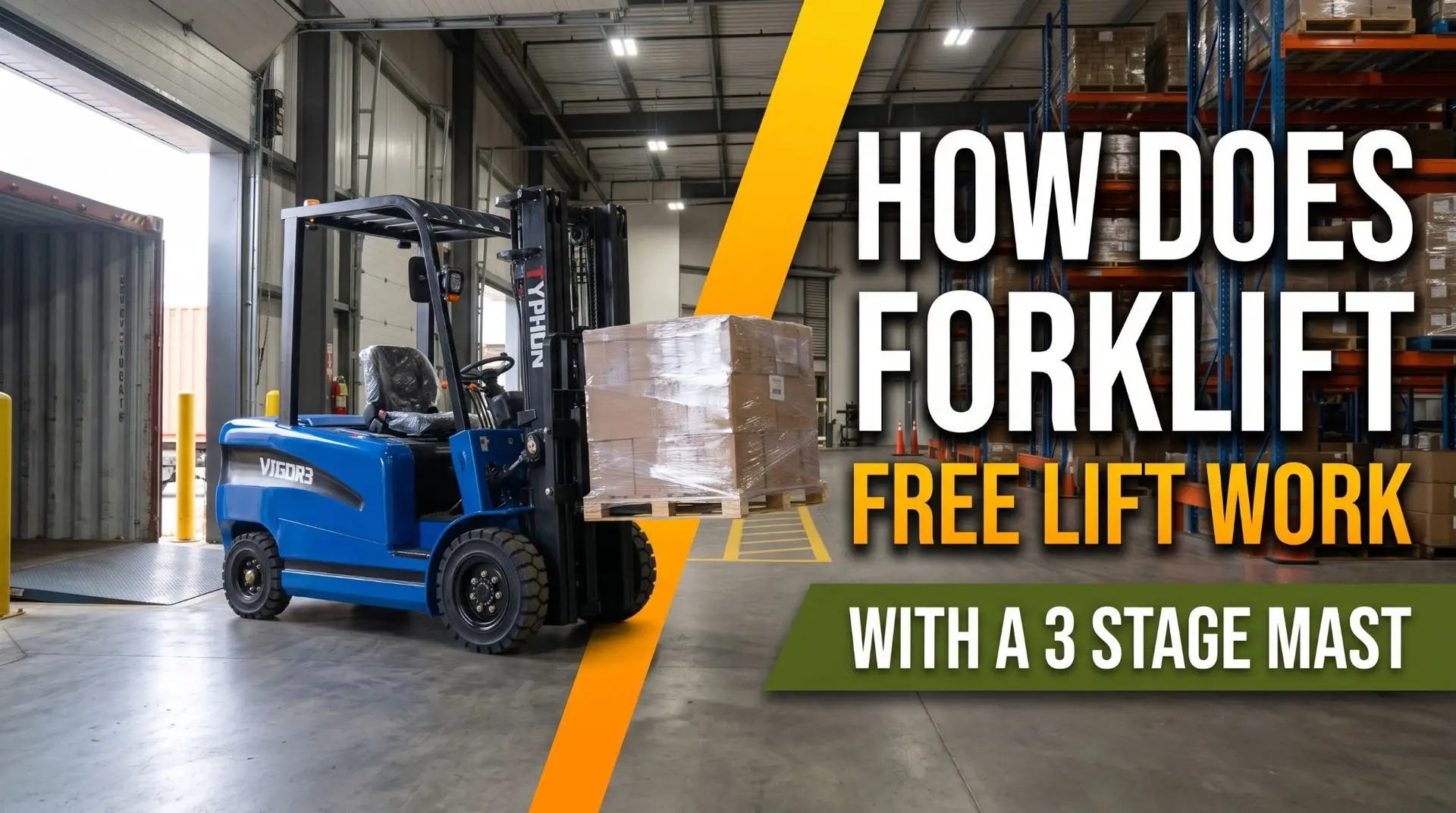
Halfway through unloading a 40-foot shipping container of boxed appliances, a receiving crew at a regional distribution center hits a problem. Their usual forklift has a two-stage standard mast. Its collapsed height clears the container door, but the mast starts rising the moment the forks lift. Every time the operator tries to raise a pallet off the floor to clear the one stacked beside it, the top of the mast rubs the container ceiling. The crew switches to a forklift with a three-stage full-free-lift mast. The operator drives inside, raises the forks several feet to lift the top pallet off its stack, and the mast stays at its collapsed height the entire time. The container is empty in half the time, with no contact damage to the container or the load.
Mast design shapes where a forklift can work as much as its capacity does. A three-stage mast, often called a triplex mast, uses three nested channel sections to reach greater lift heights while keeping the collapsed mast compact. Many triplex masts also include full free lift, which lets the forks rise a substantial distance before the mast’s overall height increases. That combination makes these forklifts valuable in trailers, shipping containers, mezzanines, and buildings with low doorways, sprinkler lines, or overhead obstructions. Knowing how the system works helps operators use it correctly and helps buyers choose a mast that fits the building, the racking, and the loads.
What Free Lift Means on a Forklift
Free lift is the distance the forks can rise before the mast’s inner sections begin extending above the collapsed mast height. During free lift, only the fork carriage moves. The outer, intermediate, and inner mast channels stay where they are, so the forklift’s overall height doesn’t change.
Manufacturers usually publish free lift as a measurement from the floor to the top of the forks at the point where the mast begins to extend. Some also note the height of the load backrest at that point, since the backrest often sets the true limit. Check the specification sheet carefully, because the measurement reference can differ between manufacturers.
Operators who confuse free lift with total lift height can strike sprinkler pipes, door headers, lights, and container roofs. Free lift tells you how much you can do inside a low space. Maximum lift height tells you how high the forks can reach once space above allows the mast to extend.
Key takeaway: Free lift is the fixed distance the forks rise before the mast sections extend and the forklift’s overall height increases, so treat it as a defined specification and never as unlimited movement.
How a Three-Stage Mast Is Constructed
Three nested sets of steel channels form the core of a triplex mast. Each section slides inside the next on load rollers, and a hydraulic and chain system coordinates their movement.
The three sections work together in sequence. The outer mast is the largest and fixed section, mounted to the forklift’s frame through the tilt cylinders and mast pivot, and it doesn’t move up or down. The intermediate mast is the middle section, which slides up inside the outer mast during the main lift. The inner mast is the smallest section, which slides up inside the intermediate mast and carries the fork carriage on its rollers. Because all three sections nest when lowered, the collapsed mast stays relatively short. Extended, they stack end to end and provide much greater fork height than a two-stage mast with a similar collapsed height.
Most full-free-lift triplex masts use two types of lift cylinders. The free-lift cylinder, often called the primary cylinder, is typically mounted in the center of the inner mast and raises the fork carriage through a set of chains running over a sheave at its top. The main lift cylinders, often called secondary cylinders, are usually mounted at the sides of the outer mast and raise the intermediate section, while a second chain set lifts the inner section along with it. Chains and sheaves multiply movement so the carriage travels farther than the cylinder rod itself extends.
Load rollers guide each section and carry side and thrust loads as the mast extends. Side thrust rollers or wear pads keep sections centered. The fork carriage rides on its own rollers within the inner mast, and the load backrest extension mounts to the carriage to keep loads from falling rearward toward the operator. Cylinder placement, chain routing, and roller arrangement vary between manufacturers. Many modern designs offset or nest cylinders and hoses to improve the operator’s view through the mast. Always confirm the lifting sequence and component layout for your specific forklift in the manufacturer’s documentation.
Key takeaway: A triplex mast combines outer, intermediate, and inner channels with a center free-lift cylinder, side main lift cylinders, chains, sheaves, and rollers, and the exact layout varies by manufacturer.
Full Free Lift and Standard Mast Configurations
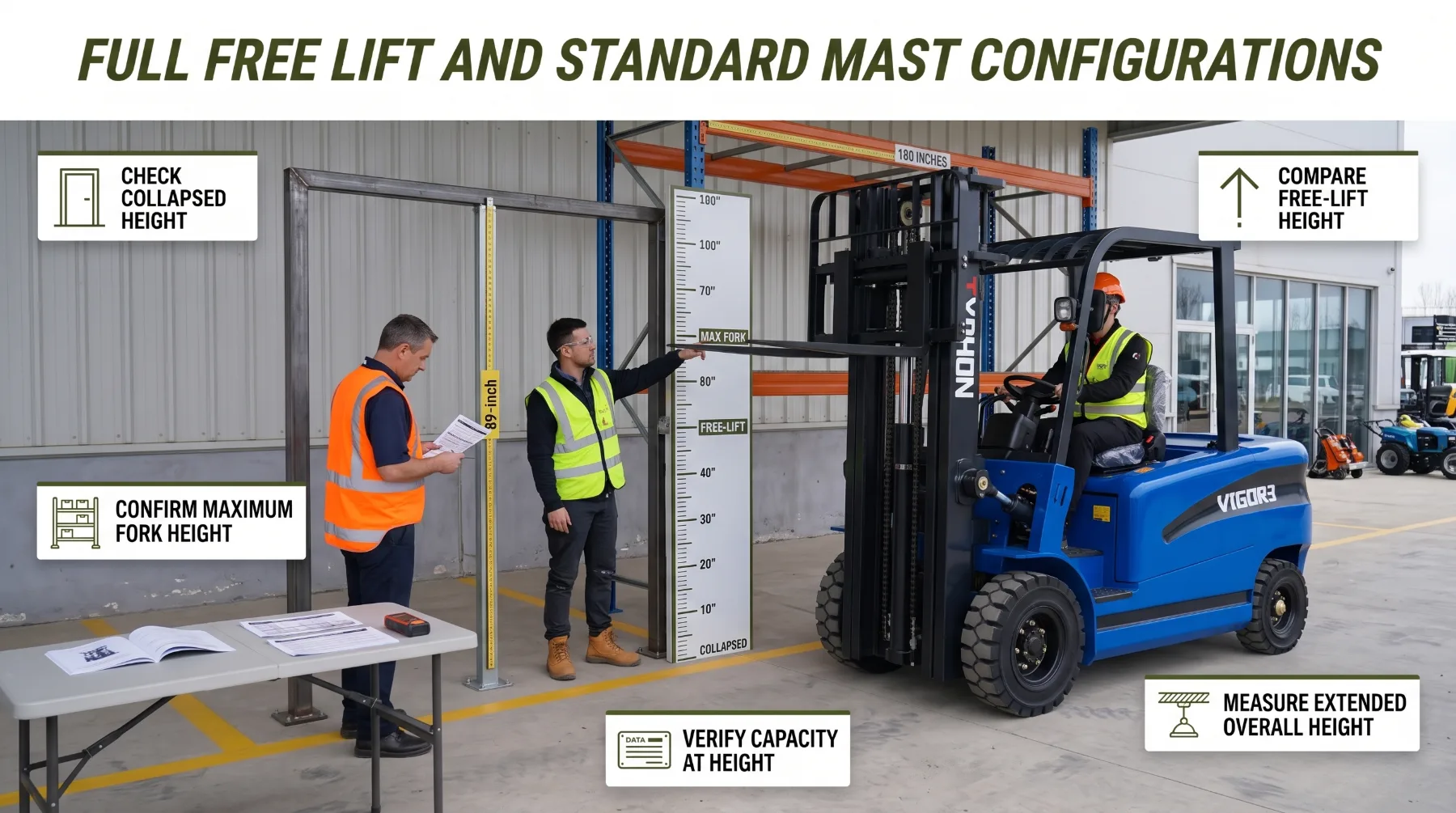
Not every mast offers the same free lift, and the differences matter in low-clearance work. Understanding the main configurations helps buyers match a forklift to the building rather than the brochure.
Mast configurations range from two-stage standard designs with limited free lift, which suit open warehouses and yards with ample overhead clearance, to two-stage full-free-lift designs that provide more carriage travel for moderate lift heights in low-clearance areas. Three-stage full-free-lift masts add greater total reach while keeping the collapsed mast relatively compact, making them well suited for containers, trailers, and taller racking in buildings with low doors. Four-stage full-free-lift designs extend that principle further for very tall storage where collapsed height must stay low. Exact values vary widely by model, mast height, and manufacturer, so always compare specification sheets for the specific configuration you plan to run.
Four figures decide whether a mast fits the application. Collapsed mast height must clear doorways, container and trailer openings, overhead pipes, and storage area ceilings with a safety margin. Free-lift height must allow the forks to lift loads within the low space you’ll work in. Maximum fork height must reach the top beam of the racking with clearance to place and remove pallets. Extended overall height must fit beneath the building’s lowest overhead obstruction at full lift.
For example, consider a container with a standard door opening height. A forklift whose collapsed mast clears that opening by a safe margin and that has enough free lift to raise pallets inside can work throughout the container without the mast striking the roof. The same machine that handles container work can then place pallets on tall racking in the warehouse if its maximum fork height is sufficient. Forklift travel speed should also match the working environment, with lower speeds used in confined spaces, narrow aisles, container interiors, and areas with pedestrian traffic. A forklift with an impressive maximum lift height may still be unsuitable for a low-clearance building if its collapsed mast is too tall, since taller masts generally have taller collapsed heights. Measure every door, container, trailer, and overhead obstruction along the routes the forklift will travel before selecting a mast, and consider travel speed, load weight, and operating conditions when planning safe movement.
Key takeaway: Compare collapsed height, free-lift height, maximum fork height, and extended overall height against your doors, containers, racking, and ceilings, because a tall maximum lift doesn’t guarantee a mast fits a low-clearance building.
How the Free-Lift Mechanism Operates
Hydraulic pressure drives the entire lifting sequence. When the operator pulls the lift control, the pump sends oil to the lift circuit, and the oil follows the path of least resistance.
During the first part of the lift, oil extends the free-lift cylinder. Its rod rises and pulls the carriage up through the chain arrangement. The outer, intermediate, and inner sections stay fully collapsed. The forks and load rise within the mast until the carriage reaches the top of the inner channel. The free-lift cylinder moves first because, on many designs, it has a larger effective piston area than the combined main cylinders, or it carries less weight relative to its area, meaning it needs less pressure to move before the main cylinders begin. The exact sequencing depends on the manufacturer’s cylinder sizing and valving.
Once the free-lift cylinder reaches the end of its stroke, pressure rises in the circuit until the main lift cylinders begin to extend. They raise the intermediate section, and chains anchored to the outer mast pull the inner section upward at the same time. The carriage, now at the top of the inner section, rides along. From this point, every additional increment of lift increases the forklift’s overall height.
Lowering usually reverses the order. The mast sections retract first under the control of the main cylinders, then the carriage descends through its free-lift travel. A flow control or lowering valve regulates descent speed, and many masts include cushioning near the end of each stroke to reduce shock as sections seat. A slight change in lifting speed or sound at the transition point is normal on many triplex masts, since the cylinders and chain ratios differ between stages. A sharp jolt, hesitation, chatter, or uneven fork travel at the transition isn’t normal and should be reported for inspection.
Key takeaway: The free-lift cylinder raises the carriage first while the mast stays collapsed, the main cylinders then extend the intermediate and inner sections, and lowering generally runs in reverse.
Inspection and Safe Operation of a Three-Stage Mast
Daily examination is required before a forklift is placed in service, and a triplex mast adds components that deserve close attention.
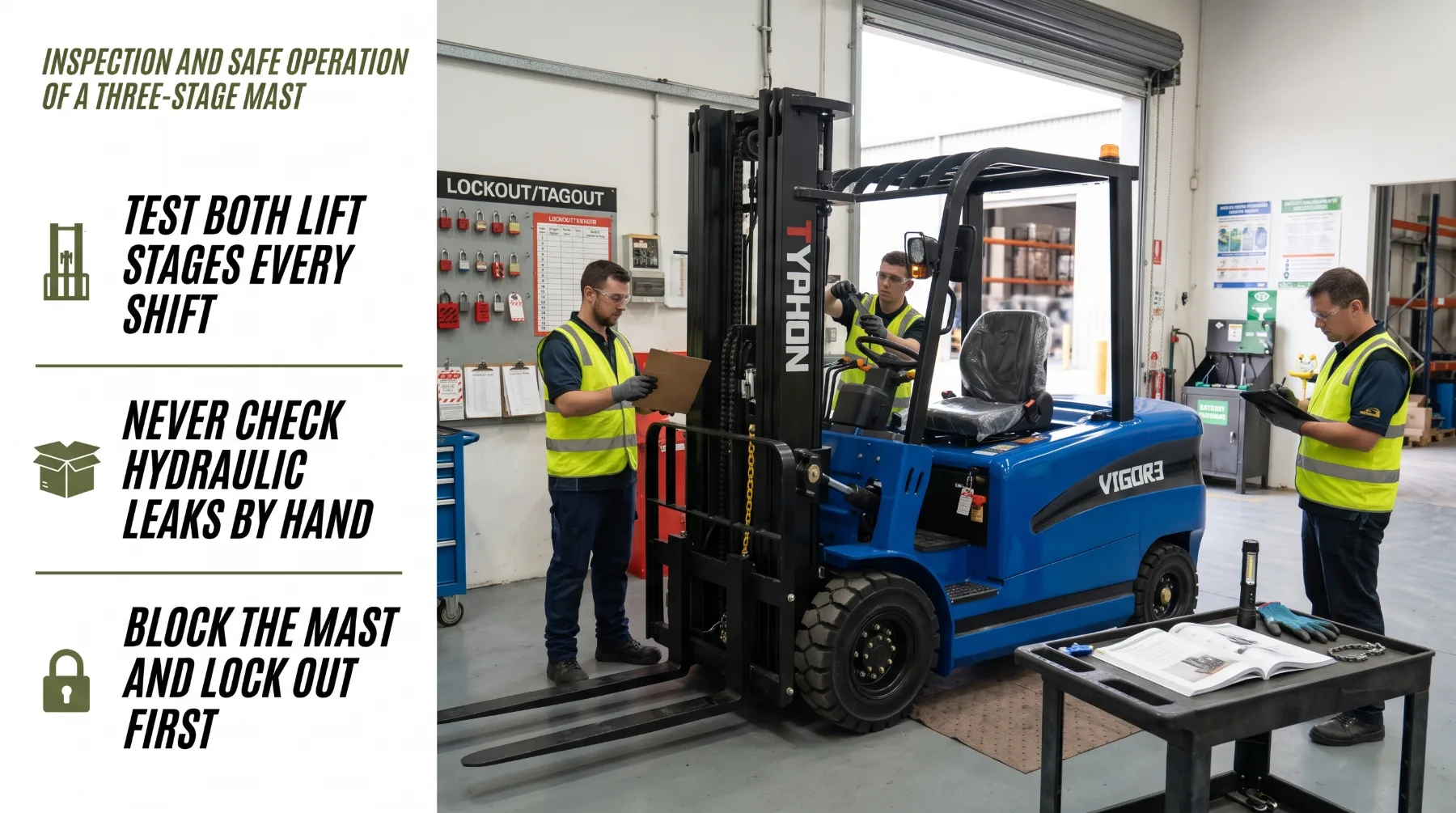
With the forks lowered and the forklift shut down, inspect mast channels for cracks, bends, damaged welds, and heavy wear on roller paths. Check rollers and wear pads for flat spots, missing rollers, and excessive play between sections. Examine lift chains for stiff or kinked links, cracked plates, turned or protruding pins, corrosion, and uneven tension. Confirm that chain anchor pins, cotter pins, and locknuts are in place and that sheaves turn freely. Inspect free-lift, main lift, and tilt cylinder rods for scoring and check for leaks at the glands. Check hoses and hose reels for abrasion, cracks, bulges, and wet spots, and confirm hoses track smoothly over sheaves. Check fork heels for cracks, confirm locking pins engage, and inspect the load backrest. Confirm the data plate is present, legible, and matches the current configuration.
Then run an unloaded function test. Raise the mast slowly through free lift and into full extension, then lower it. Watch for chatter, binding, hesitation at the transition between stages, uneven fork travel, and unusual noise. Tilt the mast forward and back, and confirm it holds without drifting.
Lift chains stretch as their pins wear, and manufacturers specify a maximum allowable elongation beyond which the chain must be replaced. Forks should be removed from service when heel thickness has worn beyond the manufacturer’s limit or when cracks are found. Never weld, heat, or straighten a fork or chain in the field.
Good operating habits protect the mast and everyone near it. Keep loads centered on the forks and tight against the load backrest, and travel with the forks low and the mast tilted slightly back. Raise and lower loads only when stopped, unless the manufacturer’s instructions specifically permit otherwise. Confirm overhead clearance before lifting beyond free-lift height, and lift smoothly without holding the lift control at the end of the stroke. Never exceed the data plate capacity for the load center, lift height, and attachment. Keep everyone clear of the mast and never allow anyone to stand or walk beneath raised forks. Never use free lift as a reason to work in an area with insufficient overhead clearance. Report jerky movement, unusual noises, uneven fork travel, or leaks immediately, and tag the forklift out of service until a qualified technician inspects it. Operators should wear the seat belt whenever the truck moves.
Key takeaway: Inspect channels, rollers, chains, cylinders, hoses, and forks every shift, function test through both lift stages, follow the data plate, and tag out any forklift with abnormal mast movement or leaks.
Safe Leak Checks, Lockout, and Mast Service
Stored energy runs through every triplex mast. The free-lift and main lift cylinders hold pressurized oil, a raised carriage or mast section holds its weight on trapped oil, and chains carry heavy loads under tension. Safe service begins by controlling all of it.
Never use your hand to search for a hydraulic leak. Fluid escaping through a pinhole under pressure can penetrate skin and cause an injection injury. The wound may look like a minor puncture at first, but it’s a medical emergency that requires immediate surgical treatment. Hold a piece of cardboard or wood near the suspected hose, fitting, or cylinder gland. Wear gloves and eye protection, and keep your face and body out of line with the leak point. If anyone is struck by escaping hydraulic fluid, get emergency medical care at once and tell medical staff it’s a hydraulic injection injury.
Before any inspection beyond the operator’s pre-shift check, and before every repair, follow these steps: park on firm, level ground away from traffic, dock edges, and ramps; lower the forks fully to the floor and set the mast vertical; place the controls in neutral and apply the parking brake; shut down the forklift and remove the key; on electric forklifts, disconnect the battery connector, and on internal combustion forklifts, disconnect the battery as the manual directs before electrical work; relieve hydraulic pressure as the manufacturer instructs; and apply your personal lock and tag according to your site’s lockout procedure, then verify isolation before starting work.
Some tasks, such as chain inspection, roller replacement, or cylinder work, require the carriage or mast sections to be raised. Secure them first with the manufacturer’s approved blocking or chaining method before anyone goes near. Never stand, walk, reach, or work beneath raised forks, a raised carriage, or extended mast sections held only by hydraulics. Never rely on improvised supports such as pallets, lumber, or stacked blocks. Chain replacement and adjustment, cylinder rebuilds, lowering valve and relief pressure work, and roller shimming all require the manufacturer’s procedures, specified parts, and correct tools. Replace chains in matched sets where the manufacturer directs, and adjust tension so both chains carry the load evenly. After any repair, check for leaks with cardboard, then cycle the mast slowly through free lift and full extension with the area clear before returning the forklift to service.
Key takeaway: Check leaks with cardboard or wood rather than your hands, lower the forks and lock out before service, secure any raised mast section with approved supports, and leave chain, cylinder, and valve work to qualified technicians.
Conclusion
Full free lift turns a three-stage mast into one of the most versatile tools in material handling. The free-lift cylinder raises the carriage while the mast stays collapsed, then the main cylinders extend the intermediate and inner sections for greater reach. That sequence lets one forklift stack inside a shipping container and place pallets on tall racks in the same shift.
Choosing well comes down to measurement. Match collapsed height, free-lift height, maximum fork height, and extended overall height to your doors, containers, racking, and ceilings, and confirm capacity at every lift height on the data plate. Then protect that investment with daily mast inspections, smooth operating habits, cardboard leak checks, and complete lockout before service. A correctly specified and well-maintained triplex mast delivers reliable lifting performance and keeps every member of your team safe.
Frequently Asked Questions
What does free lift mean on a forklift?
Free lift is the distance the forks can rise before the mast sections begin extending and the forklift’s overall height increases. During free lift, only the carriage moves within the collapsed mast. It’s a fixed specification, usually measured to the top of the forks, and it varies by mast design and manufacturer.
Does every three-stage mast have full free lift?
No. Many triplex masts include full free lift, but free-lift capability depends on the specific cylinder and chain configuration. Some masts offer limited free lift instead. Check the specification sheet for the free-lift height of the exact mast before purchasing or renting.
Why is free lift useful inside a trailer or container?
Free lift lets the operator raise a load inside a trailer or container while the mast stays at its collapsed height. That makes it possible to lift pallets off stacks, double stack, or unstack loads without the mast striking the roof or door header. The collapsed height must still clear the opening with a safe margin.
Does free lift increase forklift lifting capacity?
No. Capacity is set by the forklift’s data plate for a specified load center, lift height, and attachment. Many three-stage masts carry reduced ratings at upper lift heights, and attachments reduce capacity further. Always confirm the rated capacity for the height and load center you’ll actually use.