A forklift battery often costs as much as a small car, yet it rarely gets the attention that investment deserves. For warehouse managers and fleet supervisors, that oversight quietly drains budgets through shortened battery life, sluggish performance, and the unplanned downtime that stalls an entire shift.
The good news is that forklift battery maintenance is straightforward once you build the right habits. Consistent charging discipline, routine watering, proper cleaning, and smart handling can add years to a battery’s working life and keep your fleet running at full capacity.
By the end of this guide, you will understand exactly how to care for both lead-acid and lithium-ion batteries, what daily and weekly practices protect your investment, and how to spot the warning signs of a failing battery before it leaves an operator stranded mid-shift.
Why Battery Maintenance Deserves Your Attention
A forklift battery is not just a power source; it is a major capital asset that directly affects productivity. A well-maintained battery delivers consistent power across a full shift, holds its capacity for years, and rarely fails without warning. A neglected one loses runtime, charges unevenly, and often dies long before its rated lifespan.
The financial case is simple. A lead-acid forklift battery can last five years or more with proper care, but poor habits can cut that in half. When you multiply premature replacement costs across a fleet of 10, 20, or more machines, the stakes become clear.
Beyond cost, battery health shapes your operation’s reliability. Every minute a forklift sits idle waiting on a charge or a swap is a minute it is not moving product. Strong electric forklift battery care protects both your budget and your throughput.
Proper Charging Practices
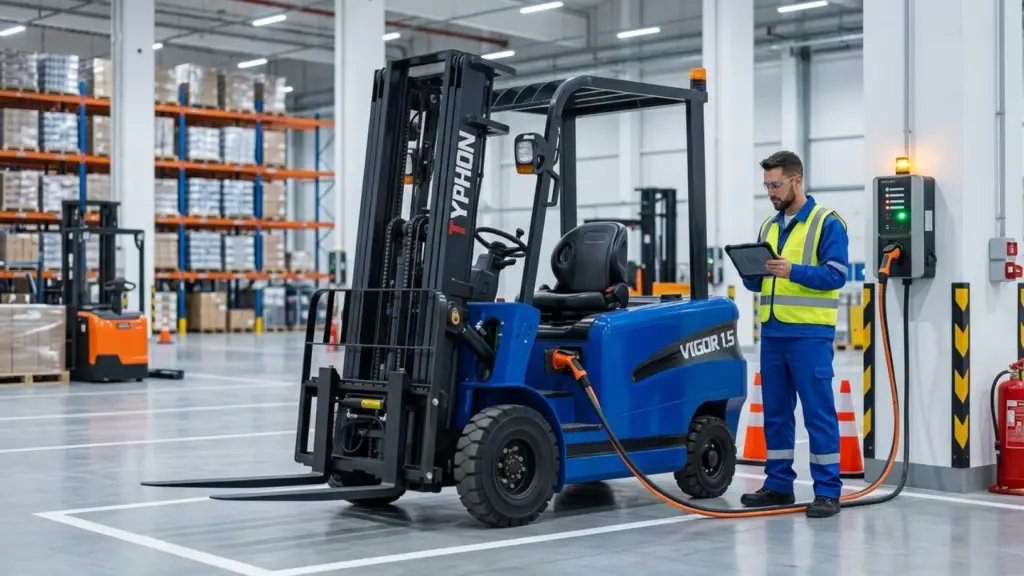
Charging is where most battery damage begins, and it is also where the biggest gains in battery life are won. Getting your charging routine right is the single most important step in extending forklift battery life.
Charge at the Right Time
For lead-acid batteries, follow a consistent charging discipline:
- Charge when the battery reaches about 20 to 30 percent capacity, not before and not after running it flat.
- Allow a full charge cycle to complete once started, rather than interrupting it partway.
- Avoid opportunity charging on lead-acid unless the battery is specifically rated for it, since frequent partial charges shorten its life.
Let the Battery Cool
Batteries generate heat during both use and charging. Whenever possible, allow a lead-acid battery to cool before charging and to cool again after charging completes, before returning it to service. Excessive heat is one of the fastest ways to degrade battery cells.
Use the Correct Charger
Match every battery to a charger sized for its voltage and capacity. An undersized or mismatched charger delivers an incomplete or damaging charge. Confirm the charger settings align with the manufacturer’s specifications for your specific battery.
Key takeaway: Charge at 20 to 30 percent, complete the full cycle, and never skip the cooldown.
Watering Lead-Acid Batteries
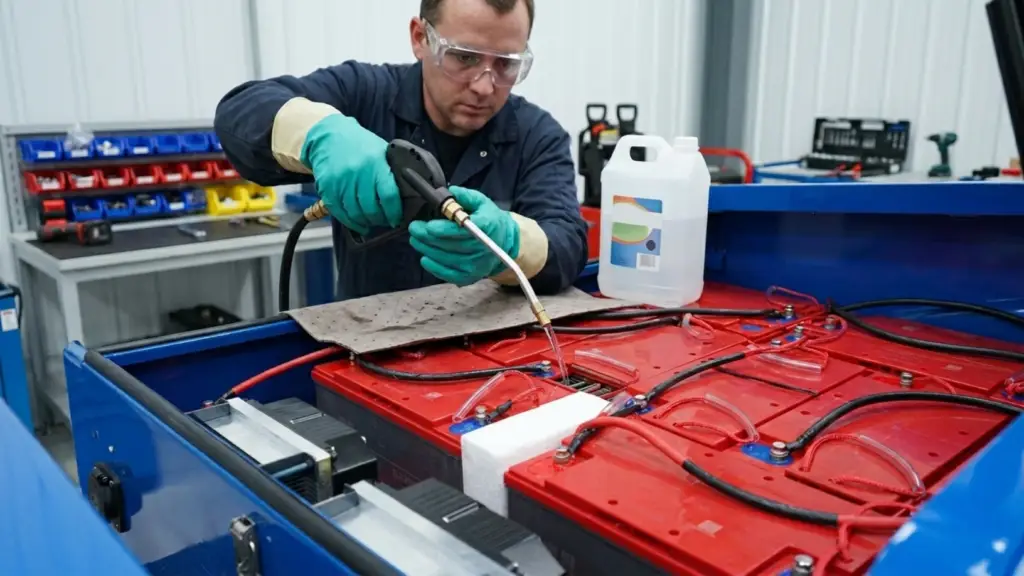
Lead-acid batteries lose water during normal operation, and replacing that water correctly is essential to their health. Skip it, and the lead plates inside the cells become exposed, causing permanent damage that no later watering can reverse.
When and How to Water
- Water after charging, not before. Charging causes the electrolyte level to rise, so filling beforehand risks overflow and acid spillage.
- Check levels weekly as a starting point, then adjust the schedule based on your fleet’s usage and how quickly the cells consume water.
- Fill to the indicated level — typically just above the plates or to the level indicator — without overfilling.
- Use distilled or deionized water only. Tap water contains minerals that contaminate the cells and reduce capacity.
Make Watering Easier
A single-point watering system delivers water to every cell at once and removes much of the guesswork from the task. For larger fleets, this investment pays back quickly by preventing the dried-out cells that ruin batteries early. Never let the plates sit exposed to air, as even brief exposure causes lasting harm.
Key takeaway: After charging, use distilled water only, and never let the plates dry out.
Equalizing Charges
Equalizing is a controlled overcharge that brings every cell in a lead-acid battery back to the same state of charge. Over time, cells drift out of balance, and weaker cells drag down the performance of the entire battery. Equalizing corrects that imbalance and removes the sulfate buildup that reduces capacity.
Run an equalizing charge on the schedule your battery manufacturer recommends, often weekly or every few charge cycles, depending on the battery. Most modern chargers include an equalization setting that handles the process automatically.
A few cautions apply. Equalizing generates extra heat and gas, so ensure the charging area is well ventilated and check water levels afterward, since the process consumes additional water. Do not equalize more often than recommended, as excessive equalizing wears the battery prematurely. Lithium-ion batteries do not require equalizing; this practice applies to lead-acid batteries only.
Avoiding Deep Discharge
Running a lead-acid battery too far down is one of the most damaging things you can do to it. Discharging below roughly 20 percent capacity stresses the cells, accelerates plate corrosion, and permanently reduces the battery’s ability to hold a charge.
Train operators to recognize the discharge indicator and to swap or charge the battery before it drops into the danger zone. Pushing a forklift to keep working on a nearly dead battery to finish one more task is a false economy — the damage costs far more than the few minutes saved.
To build this into your routine:
- Set a clear cutoff at 20 to 30 percent and make operators accountable for honoring it.
- Never store a discharged battery. A battery left sitting in a low state of charge sulfates quickly and may not recover.
- Charge promptly once a battery comes out of service, rather than letting it sit drained overnight.
Lithium-ion batteries tolerate deeper discharge far better than lead-acid, but even they perform best when you avoid running them completely flat.
Keeping Batteries Clean and Corrosion-Free
A clean battery is a reliable battery. Dirt, moisture, and acid residue on the top of a battery create paths for current to leak across terminals, which drains charge and corrodes connections over time. Corrosion on terminals and cables increases resistance, reduces power delivery, and can eventually cause a failure.
A Simple Cleaning Routine
- Inspect the battery top regularly for dirt, moisture, and white or greenish corrosion around terminals.
- Clean the terminals and cable connections to keep them tight and conductive, following your manufacturer’s guidance and safety procedures.
- Wipe up any electrolyte that escapes during watering or charging, since acid left on the surface accelerates corrosion.
- Keep connections tight, as loose terminals generate heat and reduce performance.
Always wear appropriate personal protective equipment when cleaning a battery, including gloves and eye protection, and follow your facility’s procedures for handling battery acid safely.
Safe Handling and Storage
Forklift batteries are heavy, contain corrosive acid, and store significant electrical energy, so handling and storage demand both care and discipline. Mishandling risks injury to your team and damage to a costly asset.
Handling Best Practices
- Use proper equipment for battery changes, such as a battery extractor, roller bed, or overhead hoist rated for the weight.
- Train operators on safe lifting, transport, and connection procedures before they handle batteries independently.
- Connect and disconnect carefully, ensuring the forklift is off and following the correct sequence to avoid arcing.
- Keep the charging and battery room ventilated, since lead-acid charging releases hydrogen gas that can accumulate dangerously.
Storage Considerations
If a battery will sit unused, store it fully charged and give it a maintenance charge periodically to prevent sulfation. Keep stored batteries in a cool, dry, ventilated space away from direct heat. Never store a lead-acid battery in a discharged state, as it will degrade quickly and may become unrecoverable.
Temperature Considerations
Temperature has a powerful effect on battery performance and lifespan, and many operations overlook it. Both extremes — too hot and too cold — work against you.
Heat is the more destructive of the two. High temperatures accelerate the chemical wear inside a battery, shortening its life and increasing water consumption in lead-acid units. Keep charging areas cool and well ventilated, avoid charging a battery that is already hot, and never let batteries sit in direct sun or near heat sources.
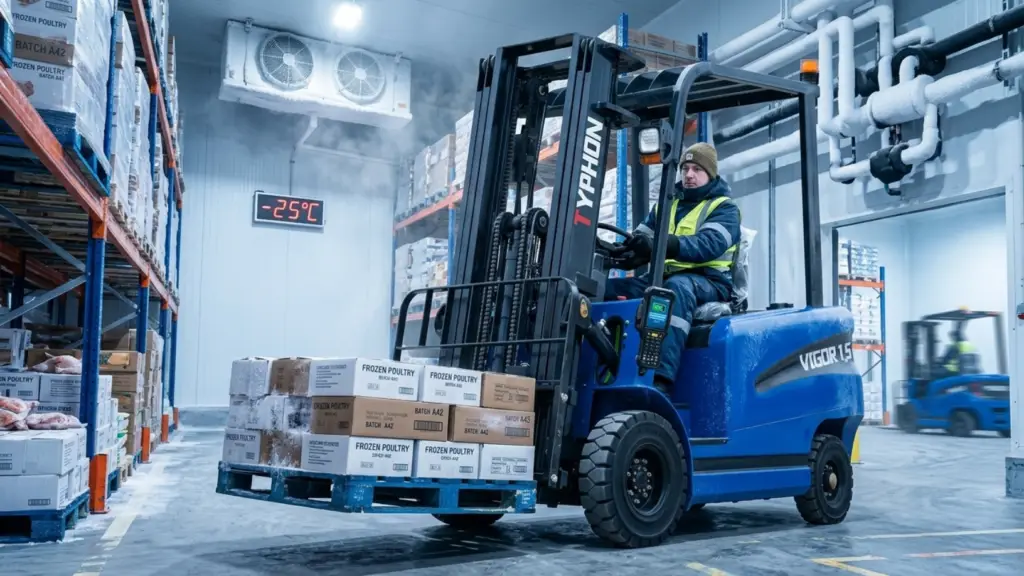
Cold reduces a battery’s available capacity and runtime. In cold storage and freezer operations, a lead-acid battery may deliver noticeably less power per shift, which is one reason lithium-ion batteries have gained popularity in refrigerated environments. If your operation runs in the cold, account for reduced capacity in your shift planning and consider batteries rated for low-temperature service.
Key takeaway: Protect batteries from heat above all, and plan for reduced capacity in cold environments.
Lithium-Ion vs. Lead-Acid Maintenance Differences
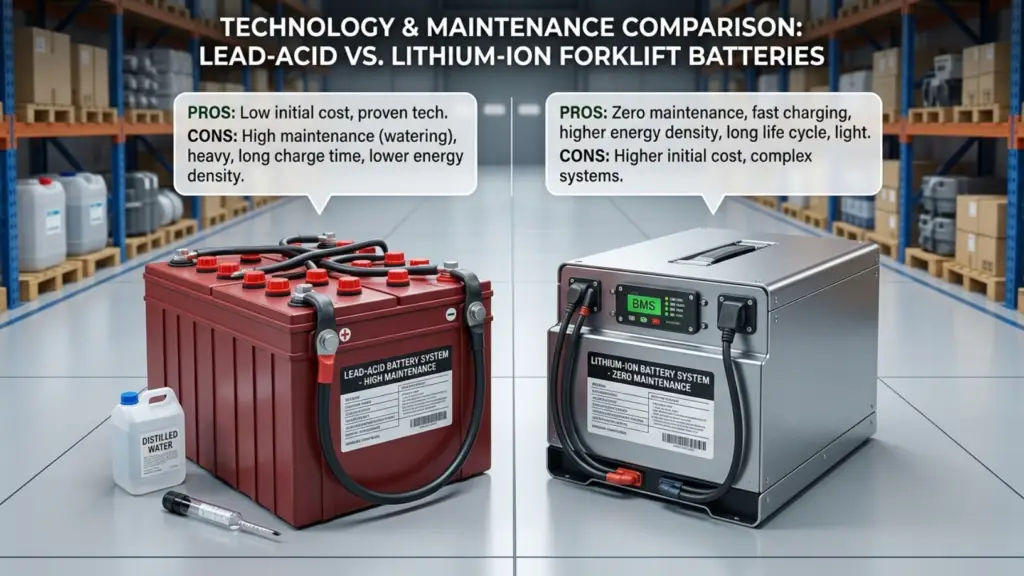
Understanding how these two battery types differ helps you tailor your maintenance program correctly. Each has distinct needs.
Lead-Acid Maintenance
Lead-acid batteries are proven and affordable, but they demand consistent hands-on care:
- Regular watering with distilled water
- Periodic equalizing charges
- Cooldown periods between charging and use
- Careful avoidance of deep discharge and partial charging
- Routine cleaning to manage acid and corrosion
This maintenance is manageable, but it requires discipline and labor across the fleet.
Lithium-Ion Maintenance
Lithium-ion batteries are designed to reduce maintenance significantly:
- No watering required — the cells are sealed.
- No equalizing needed.
- Opportunity charging is built in, so operators can top up during breaks without harming the battery.
- Less downtime, since there is no cooldown period and no battery swapping for many operations.
- Tolerance for partial charging and deeper discharge without the damage lead-acid suffers.
Lithium-ion batteries carry a higher upfront cost, but their lower maintenance burden, longer cycle life, and reduced labor often deliver a stronger total cost of ownership in high-utilization, multi-shift operations. The right choice depends on your shift structure, utilization, and budget.
Signs of a Failing Battery
Even with excellent care, every battery eventually wears out. Recognizing the warning signs early lets you plan a replacement on your terms rather than reacting to a dead battery in the middle of a shift.
Watch for these indicators:
- Shorter runtime. The battery no longer powers a full shift the way it once did, even after a complete charge.
- Longer charging times or charges that never seem to complete properly.
- Excessive heat during charging or use, beyond the battery’s normal warmth.
- Visible damage such as a swollen or cracked case, leaking electrolyte, or heavy corrosion.
- Inconsistent performance, including sudden power drops or voltage that sags under load.
- Cells that fall out of balance repeatedly despite regular equalizing on a lead-acid battery.
When you notice these signs, test the battery to confirm its condition and budget for a replacement before it fails completely. A failing battery left in service strains the forklift’s components and risks stranding an operator at the worst possible moment.
Key takeaway: Declining runtime, excessive heat, and visible damage are your cues to test and plan a replacement.
Building a Battery Maintenance Program
Individual tips help, but the operations that get the most from their batteries build these practices into a consistent, documented routine. A program turns good intentions into reliable habits.
Start by assigning clear responsibility. Someone should own battery care, whether that is a dedicated team in a larger operation or a trained supervisor in a smaller one. Then build a simple schedule that covers daily, weekly, and periodic tasks:
- Daily: Check charge levels, watch for deep discharge, and keep batteries clean.
- Weekly: Check and top off water levels with distilled water, and run equalizing charges as recommended.
- Periodically: Inspect for corrosion and damage, test battery capacity, and review performance trends across the fleet.
Train every operator on the fundamentals, since they handle these batteries every shift. When charging discipline, proper watering, and damage awareness become second nature, your fleet runs longer and fails less.
Conclusion
Forklift battery maintenance comes down to a handful of disciplined habits: charge correctly, water lead-acid batteries on schedule, equalize as recommended, avoid deep discharge, keep batteries clean, handle them safely, and protect them from temperature extremes. Together, these practices extend battery life, sustain performance, and cut the downtime that disrupts your operation.
The payoff is real. A well-maintained battery can deliver years of dependable service, while a neglected one fails early and costs you far more than the maintenance ever would.
Start by reviewing your current charging and watering routines this week, and confirm that every operator knows the deep-discharge cutoff. From there, build out a documented program with clear ownership and a regular schedule. Put these forklift battery maintenance tips into practice, and you protect both your fleet and your bottom line for every shift that follows.