Forklifts are involved in nearly 85 fatal accidents and 34,900 serious injuries in the United States every year, according to OSHA. The troubling reality is that the vast majority of those incidents are preventable. They trace back to the same repeatable mistakes: skipped inspections, untrained operators, ignored warning signs, and poor pedestrian management protocols.
If you manage a warehouse, lead a safety program, or oversee industrial operations, this guide is for you. Understanding which forklift safety mistakes cause the most harm, and building systems to prevent them, is one of the highest-return investments your organization can make.
Key takeaways from this post:
- The most dangerous forklift mistakes are operational and behavioral, not mechanical
- Pre-shift inspections and certified operator training prevent a disproportionate share of incidents
- Pedestrian management requires facility design, not just signage
- Overloading and improper load handling are leading causes of tip-overs
- A strong safety culture reduces risk more effectively than rules alone
Why Forklift Safety Mistakes Keep Happening
Most forklift accidents do not happen because people do not care about safety. They happen because unsafe habits form gradually, warning signs are normalized over time, and the consequences of small shortcuts are invisible until they are not.
A team that skips pre-shift inspections for months without incident begins to treat the inspection as optional. An operator who takes corners too fast for a year without a tip-over develops false confidence. Management that tolerates pedestrians in forklift zones accepts an elevated risk level — until the day that risk materializes.
Forklift accident prevention requires constant, deliberate attention. Here is where to start.
Mistake 1: Skipping the Pre-Shift Inspection
The pre-shift inspection is the single most important safety habit in any forklift operation. It is also one of the most frequently skipped, especially under production pressure.
When operators bypass the inspection, they drive machines with unknown defects onto a live floor. A hydraulic hose that was weeping at shift end could fail completely under load. Tires with embedded debris can blow out on a ramp. Brakes that felt soft yesterday may have degraded further overnight.
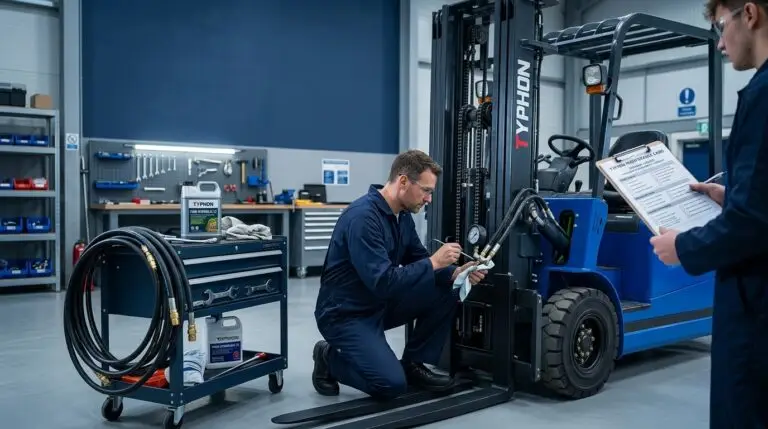
What a thorough pre-shift inspection covers:
- Forks for bends, cracks, and heel wear
- Mast chains for proper tension and lubrication
- Hydraulic hoses and cylinders for leaks or damage
- Brakes — both service and parking
- Tires for cuts, wear, and correct pressure (pneumatic)
- Horn, lights, and reverse alarm functionality
- Seatbelt condition and buckle integrity
- Battery charge level and connector condition (electric models)
OSHA requires documented pre-shift inspections under 29 CFR 1910.178. Build this into your shift-start process with a standardized form, and make it clear that a defective machine goes out of service immediately, not at the end of the shift.
Mistake 2: Speeding and Ignoring Travel Speed Limits
Forklifts are not designed for speed. They are designed for stability under load, and that stability deteriorates quickly as travel speed increases. Yet speeding is one of the most common warehouse forklift safety violations on high-throughput floors.
A fully loaded forklift traveling too fast around a corner has a very high center of gravity. The physics of tip-overs are unforgiving; once lateral momentum overcomes stability, the operator has no corrective action available. Tip-overs are among the leading causes of forklift fatalities, and they happen in seconds.
How to prevent it:
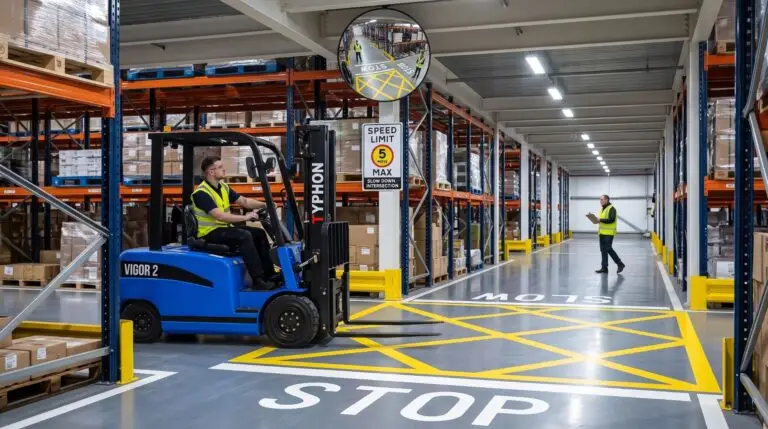
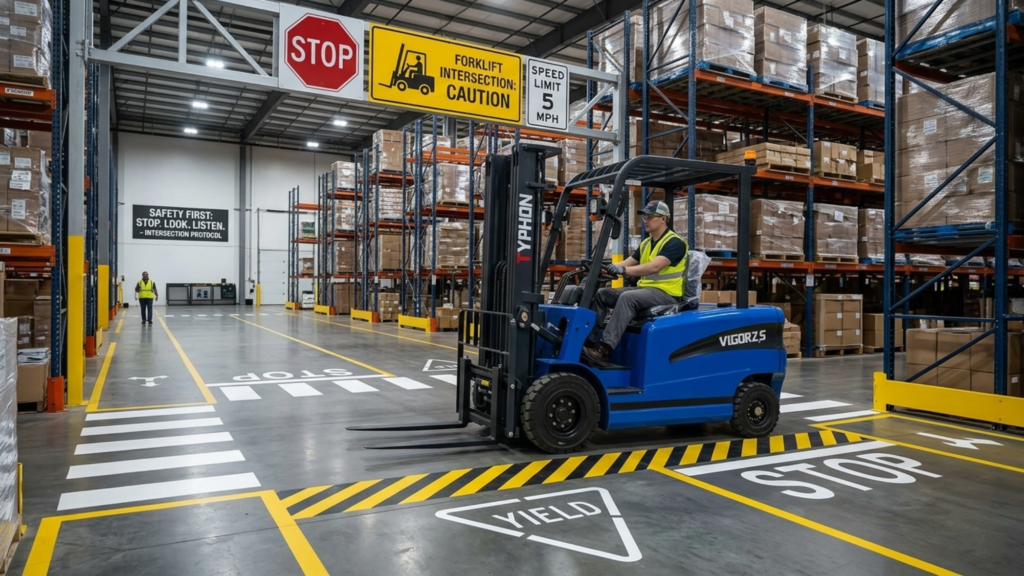
- Post clear speed limits at every aisle entrance, typically 3 to 5 mph indoors
- Install physical speed control zones (speed bumps or chicanes) at high-risk intersections
- Use telematics systems that alert management when speed thresholds are exceeded
- Address speeding immediately and consistently; one unaddressed violation signals that the rule is optional
Operators should also slow below posted limits in pedestrian zones, at blind corners, on ramps, and whenever visibility is reduced by the load they are carrying.

Mistake 3: Improper Load Handling
Improper load handling is responsible for a large share of forklift tip-overs, dropped loads, and rack collapses. The mistake often comes from overconfidence — operators who have made thousands of successful lifts assume they know when a load is within the machine’s limits.
The reality is more complex. A forklift’s rated capacity changes depending on load center distance, mast tilt, and lift height. A machine rated for 5,000 pounds at a standard 24-inch load center may safely handle considerably less when lifting high or when the load’s center of gravity is positioned further from the mast face.
Common load handling mistakes include:
- Carrying loads too high during travel (more than 6–8 inches off the floor)
- Tilting the mast forward while elevated
- Failing to center loads squarely on both forks
- Moving unstable or unsecured loads without wrapping or stabilization
- Attempting to lift loads that exceed the machine’s capacity for the specific configuration
Operators should always verify load weight against the forklift’s data plate before lifting. When in doubt, weigh the load. Never guess. A single dropped load can injure workers, damage product worth far more than the load itself, and compromise rack structures in ways that create cascading failure risk.
Mistake 4: Overloading the Forklift
Overloading deserves its own section because it is so common and so consequential. The forklift’s data plate specifies the rated capacity and that number is non-negotiable. Operating above it does not just risk an incident; it guarantees accelerated mechanical wear and dramatically increases the probability of a tip-over or structural failure.
Overloading most frequently occurs when operators combine heavy loads with elevated lift heights or when multiple pallets are stacked on the forks to reduce trip counts under production pressure.
What to do instead:
- Train operators to read and apply the load capacity chart on the data plate
- Create a culture where operators can refuse an overloaded lift without fear of repercussions
- Provide scale access in receiving and staging areas when load weights are uncertain
- For consistently heavy loads, evaluate whether a higher-capacity machine is the right specification
The short-term productivity gain from an overloaded lift is never worth the risk it creates.
Mistake 5: Distracted Operation
Distracted driving is as dangerous on a forklift as it is on a public road. Phone use, conversations with co-workers, and divided attention during high-traffic periods all reduce an operator’s reaction time and situational awareness.
A forklift traveling at 4 mph covers nearly 6 feet per second. At that speed, a distracted operator has very little margin to respond to a pedestrian stepping into the aisle or a load shift during a corner.
Practical prevention steps:
- Enforce a clear, written no-phone policy for operators while the forklift is in motion
- Brief operators regularly on the risks of distraction use near-miss data from your own facility when it exists
- Redesign high-distraction environments: reduce unnecessary noise, improve aisle lighting, and eliminate conditions that compete for operator attention
- Recognize that fatigue is a form of distraction; monitor shift length and rotate operators in high-intensity applications
Mistake 6: Poor Pedestrian Awareness and Management
This is one of the most serious forklift safety mistakes a facility can make, and it operates at both the operator level and the organizational level. Forklift-pedestrian contact incidents are among the most fatal in warehouse environments.
Operators must be vigilant. But vigilance alone is not sufficient when the facility’s physical layout and management systems force pedestrians and forklifts to share space without clear separation.
Operator-level best practices:
- Slow to a walking pace whenever entering pedestrian zones
- Make eye contact with any visible pedestrian before proceeding; never assume they have seen you
- Use the horn at every blind corner and aisle intersection
- Give pedestrians the right of way without exception
Facility-level controls that matter more:
- Designated pedestrian walkways marked with high-contrast floor striping and physical barriers
- Forklift-only travel aisles that eliminate pedestrian access entirely where feasible
- Convex mirrors at every blind intersection
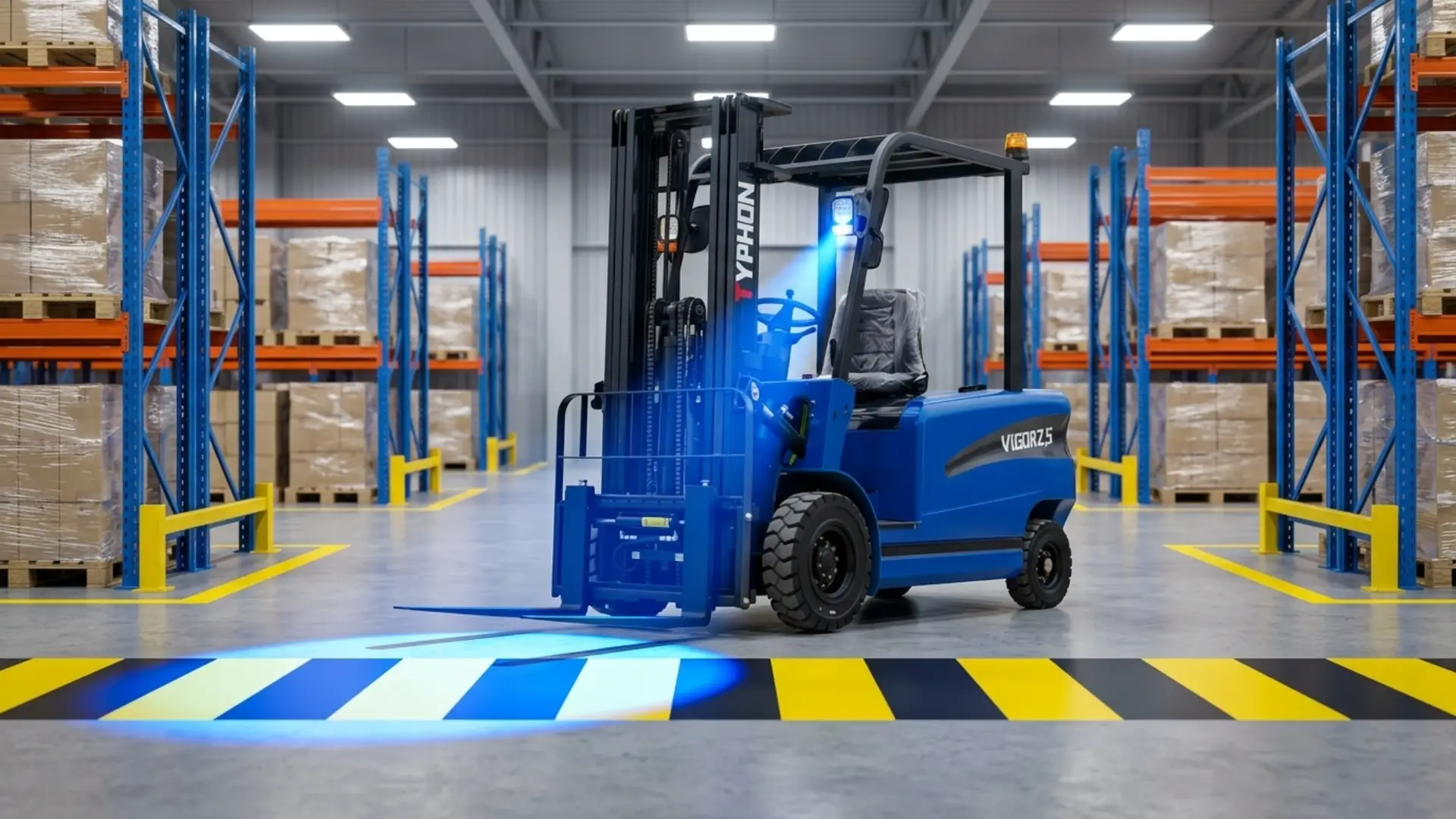
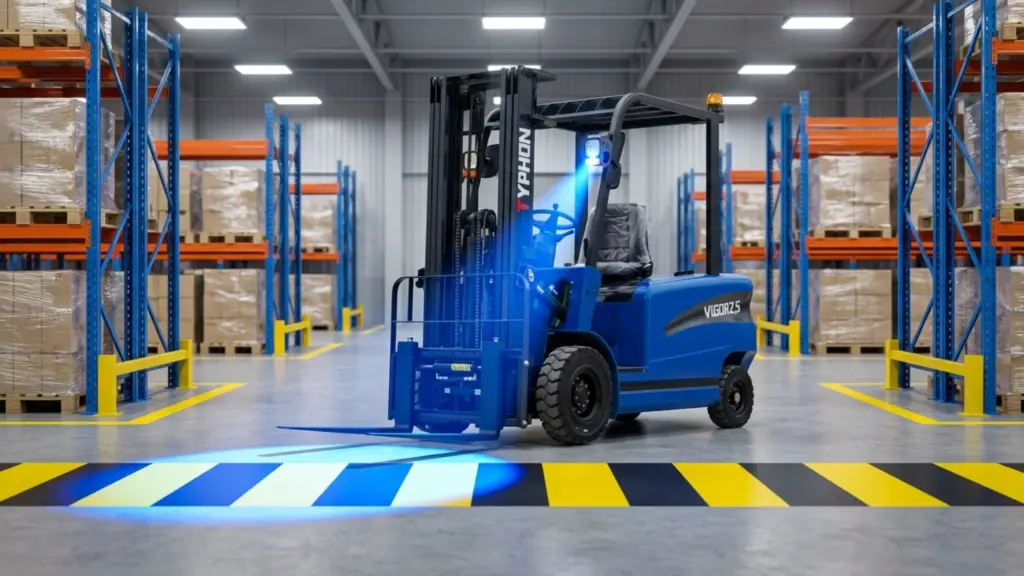
- Blue safety lights on forklifts that project a visible warning ahead of the machine
- Controlled entry points at dock doors and warehouse entrances with clear stop procedures
Behavioral rules change slowly and are difficult to enforce consistently. Physical design changes work around the clock. Prioritize facility controls over signage-only solutions.
Mistake 7: Unsafe Turning
Tight turns at speed are one of the leading mechanical causes of forklift tip-overs. Because forklifts steer from the rear axle and carry their loads at the front, they handle very differently from passenger vehicles. Many operators underestimate how quickly lateral forces build during a turn, especially when carrying a load at height.
The risk compounds on ramps, dock plates, and any surface with a cross slope. Even small elevation changes at the wrong point in a turn can transfer enough lateral force to initiate a tip.
How to prevent turning incidents:
- Slow significantly before every turn; never enter a corner at full travel speed
- Approach turns in a wide arc rather than cutting the corner sharply
- Always lower the load before traveling and keep it as low as safely possible
- On ramps, travel straight up and straight down; never turn on a slope
- Tilt the mast back slightly to shift the load toward the mast and lower the effective center of gravity
If a tip-over does begin, operators must never jump from the machine. The training response is to grip the steering wheel, brace feet, and lean away from the direction of the fall. This is counterintuitive and must be practiced deliberately in training.
Mistake 8: Improper Battery and Fuel Handling
Battery and fuel handling mistakes create chemical and fire hazards that extend well beyond the forklift itself. Mishandled lead-acid batteries produce hydrogen gas. Propane leaks near ignition sources can trigger explosions. Both hazards are entirely manageable with the right protocols in place — and both become dangerous when those protocols are ignored.
For electric forklifts with lead-acid batteries:
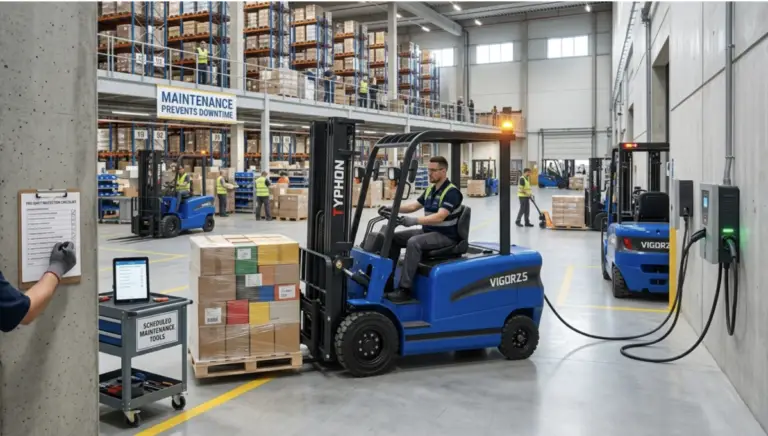
- Always open the battery compartment cover before charging to allow hydrogen gas to dissipate
- Charge batteries only in designated, well-ventilated areas away from open flames and combustible storage
- Wear acid-resistant gloves and eye protection when physically handling batteries
- Never smoke or use open flames near the charging area
- Inspect charger cables before every use; never use a charger with damaged insulation
For propane-powered forklifts:
- Inspect propane tanks for valve damage, corrosion, and proper seating before connecting
- Change tanks outdoors or in well-ventilated areas
- Store tanks in designated upright holders away from heat sources
- Train operators to shut off the gas valve when the forklift is not in use
These are not burdensome protocols. They take minutes and prevent incidents that can shut down an entire facility.
Mistake 9: Lack of Certified Operator Training
OSHA 29 CFR 1910.178 requires that forklift operators be certified before operating independently. Despite this clear requirement, inadequately trained operators remain one of the most persistent risk factors in warehouse forklift safety.
Certification is not a one-time checkbox. It requires formal instruction, practical evaluation on the specific equipment type the operator will use, and regular refresher training triggered by operational changes or safety concerns.
Forklift operator training must include:
- Formal instruction covering equipment-specific controls and load capacity limits
- Hands-on operation with an evaluator present before independent operation
- Facility-specific hazard awareness — blind spots, traffic patterns, dock procedures
- Emergency response procedures including tip-over protocol
- Battery safety or fuel handling relevant to the machine type
Retraining is required when:
- An operator is observed operating unsafely
- An incident or near-miss occurs involving that operator
- The operator is assigned to a different forklift class
- Conditions in the work environment change significantly
Do not wait for an incident to schedule retraining. Build quarterly safety reviews into your standard training calendar and treat certification as an ongoing process rather than a one-time event.
Mistake 10: Ignoring Maintenance Issues and Defect Reports
A forklift with a known mechanical defect that continues to operate is not just an equipment problem; it is a management failure. When operators report issues and those reports are not acted on, the safety culture message is clear: production takes priority over people.
Common maintenance issues that get ignored or deferred:
- Soft or spongy brakes
- Warning lights that appear and are reset without investigation
- Hydraulic hoses that are leaking or visibly aged
- Tires worn below safe operating condition
- Horns or reverse alarms that are intermittent or non-functional
Every one of these defects has the potential to cause a serious incident. The inspection process only has value if defects trigger immediate action.
Build a maintenance response system:
- Create a formal out-of-service tag that operators can apply to defective equipment
- Guarantee that tagged equipment is never returned to service before the defect is resolved
- Set response time standards for maintenance requests — urgent safety defects within hours, not days
- Track defect trends by machine and use that data to guide fleet replacement decisions
Operators who report issues and see prompt action become advocates for the safety program. Operators who report issues and see nothing change stop reporting. Protect your reporting culture by responding visibly and quickly.
Building a Safety Culture That Lasts
Individual rules and checklists are necessary, but they are not sufficient. The warehouses with the best safety records share a common characteristic: safety is treated as an organizational value, not a compliance requirement.
That means managers follow the same rules they expect operators to follow. It means near-misses are reported and investigated without blame. It means safety performance is measured and reviewed with the same rigor as throughput and cost metrics.
Start with the fundamentals: enforce pre-shift inspections, certify every operator, establish clear pedestrian controls, and respond immediately to every maintenance report. Build those habits into the rhythm of daily operations. Then use incident data, near-miss reports, and regular audits to identify the gaps that are not yet visible.
Conclusion
The most dangerous forklift safety mistakes are not rare or exotic. They are the everyday shortcuts that accumulate slowly until the consequences become unavoidable. Skipped inspections, untrained operators, poor pedestrian separation, and ignored maintenance reports form the foundation of most forklift incidents — and every one of them is preventable.
Review your current safety protocols against the mistakes covered in this guide. Identify the two or three areas where your operation carries the highest exposure and take action there first. Enforce pre-shift inspection completion, verify that every operator on your floor holds current certification, and design your facility layout to physically separate pedestrians from forklift traffic wherever possible.
A safer floor is a more productive floor. The investment you make in forklift accident prevention today directly protects your people, your operation, and your business tomorrow.