Picking a skid steer often comes down to one specification that shapes everything else: operating weight. It influences how stable the machine feels under load, how easily you can haul it between sites, how much fuel it burns, and how well it performs on the ground you actually work. Choose too light, and the machine strains against your daily tasks. Choose too heavy, and you pay for capability you never use while risking damage to soft or finished surfaces. This guide walks you through what operating weight means, how to match it to different jobs, how it affects lifting and stability, the site conditions that shape your decision, and the common mistakes worth avoiding so you invest in the right machine.
Understanding Skid Steer Operating Weight
Operating weight is the total weight of a skid steer ready to work, including a full fuel tank, standard fluids, and the operator. It is one of the first specifications you should study, because it tells you far more about real-world behavior than horsepower alone. Manufacturers group skid steers into weight classes for exactly this reason, and that single figure gives you a reliable starting point for judging whether a machine suits your work, your transport setup, and your budget.
The reason operating weight matters comes down to how deeply it shapes performance. A heavier machine plants itself more firmly on the ground, providing the counterbalance that keeps it steady when lifting and carrying loads at the front. That same weight, however, carries trade-offs you cannot ignore. It affects how you transport the machine, since a heavier skid steer may require a larger trailer and truck to move legally and safely between sites. Weight also influences fuel consumption, as a heavier machine generally burns more fuel to move and operate throughout a shift.
Operating weight touches nearly every part of ownership and daily use:
- Stability improves with greater weight, keeping the machine planted under load.
- Transport requirements rise as weight increases, affecting trailer and truck needs.
- Fuel consumption tends to climb with a heavier machine working the same tasks.
- Jobsite performance depends on matching weight to the ground and the work at hand.
Understanding operating weight from the start gives you a clear standard to measure any machine against. Rather than guessing whether a skid steer fits your operation, you can weigh its class directly against your tasks, your terrain, and how you plan to move it. That clarity is the foundation of a confident, cost-effective purchasing decision.
Choosing the Right Weight for Different Types of Jobs
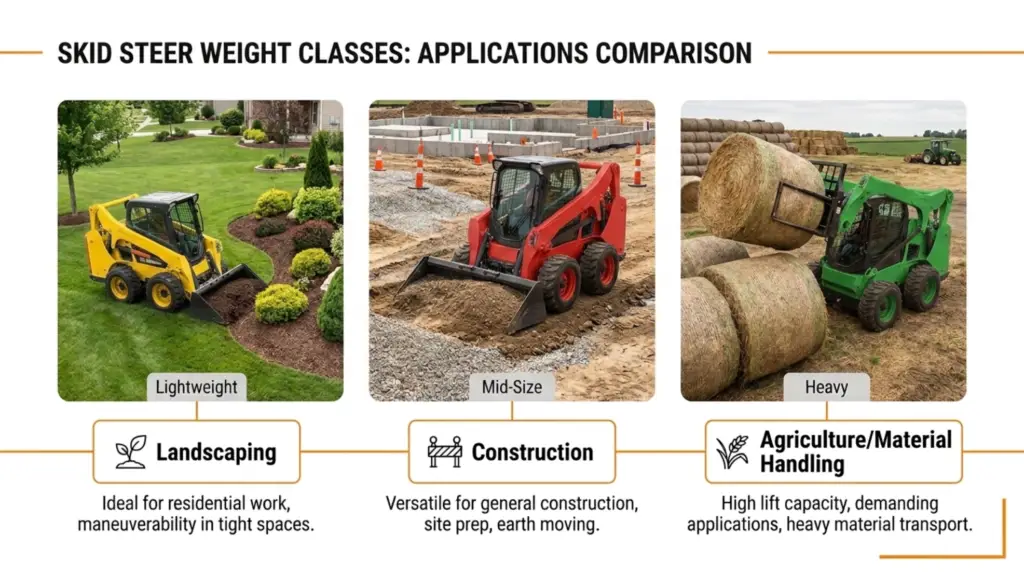
Different tasks call for different machine sizes, and matching the weight class to your work is what separates smooth productivity from constant frustration. Skid steers generally fall into three categories: lightweight, mid-size, and heavy. Each is built for a distinct kind of job, and understanding where each excels helps you choose a machine that fits the demands you face most often rather than one that overshoots or falls short.
Lightweight skid steers are nimble and easy to transport, making them well suited to landscaping, light residential work, and jobs on finished or delicate surfaces. Their lower ground pressure means less risk of tearing up lawns or cracking pavement, and their smaller size lets them work in tight yards and through narrow gates. Mid-size machines strike a balance between agility and muscle, handling the broad range of construction, material handling, and general contracting work that most operations depend on day to day. Heavy skid steers, meanwhile, bring the stability and power that demanding construction, agriculture, and heavy material handling require, moving dense loads and running large attachments with confidence.
Matching the class to your typical work makes the choice clearer:
- Landscaping: Lightweight machines protect finished ground and maneuver in tight spaces.
- Construction: Mid-size to heavy models handle grading, loading, and site prep reliably.
- Agriculture: Heavier machines manage bales, feed, manure, and demanding farm tasks.
- Material handling: Mid-size and heavy skid steers lift and move dense loads steadily.
The right choice depends on the reality of your workload, not on the temptation to buy the biggest option available. A landscaper burdened with a heavy machine damages surfaces and wastes fuel, while a contractor with an undersized skid steer struggles through every heavy lift. Assess the jobs you take on most often, weigh them against these classes, and you will land on the weight range that keeps your work efficient and your costs in check.
How Operating Weight Impacts Lifting Capacity and Stability
Operating weight ties directly to two of the most important qualities a skid steer offers: lifting capacity and stability. Heavier machines carry more mass at the rear, which acts as a counterbalance to the load lifted at the front. This balance is what allows a heavy skid steer to raise and carry more weight safely, since the machine resists the forward pull that would otherwise tip a lighter unit. When your work involves lifting dense materials, loading trucks, or running heavy attachments, that added stability and capacity translate directly into safer, more productive lifts.
Lighter machines take the opposite approach, trading some lifting muscle and stability for greater agility. They move quickly, turn easily, and work comfortably in confined spaces and on delicate surfaces where a heavier machine would struggle or cause damage. For tasks that prioritize speed, maneuverability, and a gentle footprint over raw lifting power, a lighter skid steer often proves the smarter, more efficient choice. The key is recognizing that neither approach is universally better; each serves a different set of demands.
Finding the right balance means weighing what your work truly requires:
- Heavier machines deliver greater stability and higher lifting capacity for demanding loads.
- Lighter machines offer agility, speed, and easier handling in tight or delicate settings.
- The right balance matches lifting needs against maneuverability and ground impact.
Working safely and efficiently depends on understanding this trade-off before you buy. A machine that lifts your heaviest routine loads with comfortable margin keeps every lift stable and secure, while one chosen purely for agility may leave you struggling at the limit. Weigh your typical loads, the heights you lift to, and the spaces you work in, then choose the operating weight that gives you the capacity you need without sacrificing more agility than your work can spare.
Jobsite Conditions That Influence Your Choice
The environment you work in plays just as large a role in choosing operating weight as the tasks themselves. Terrain is the starting point. On firm, level ground, a heavier machine performs beautifully, using its weight to lift and dig with confidence. On soft, muddy, or uneven terrain, that same weight can become a liability, as a heavy skid steer risks sinking or leaving deep ruts where a lighter machine would travel cleanly. Reading your terrain honestly helps you avoid choosing a machine that fights the ground rather than working with it.
Ground conditions and surface sensitivity deserve equal attention. Finished surfaces like pavement, turf, and interior floors demand a machine with lower ground pressure to avoid cracking, tearing, or marking the work area. Heavier machines concentrate more weight onto the ground and can damage delicate surfaces, while lighter units tread more gently. Workspace size and access points round out the picture, since a large, heavy skid steer may be too bulky for tight yards, narrow gates, or confined interior work, and may prove difficult to transport to sites with limited access.
Several site factors should guide your decision:
- Terrain determines whether a heavier machine grips confidently or risks sinking and rutting.
- Ground conditions influence how much surface damage a machine’s weight may cause.
- Workspace size dictates whether a larger, heavier machine can maneuver effectively.
- Access points affect both transport and whether the machine can reach the work area.
Matching the machine to its environment improves productivity and reduces wear on both the equipment and the ground you work. A skid steer suited to your terrain, gentle enough for your surfaces, and sized to fit your spaces will outperform a poorly matched machine every time. Before you commit, walk through the conditions you face most often and weigh them against each weight class, and you will select a machine that works with your sites rather than against them.
Common Mistakes When Selecting a Skid Steer
Even experienced buyers stumble when choosing operating weight, and the most frequent error is reaching for a machine that is simply too heavy. It is tempting to assume that more weight means more capability, but an oversized skid steer costs more to buy, burns more fuel, and proves harder to transport than lighter work requires. On delicate surfaces and soft ground, its weight causes damage and sinking that a properly sized machine would avoid entirely. Paying for capacity you never use, while fighting the machine’s bulk on every tight site, drains both your budget and your productivity.
Choosing a machine that is too light creates the opposite problem. An underweight skid steer strains against loads it cannot handle safely, forcing you to split tasks, work slowly, and push the equipment toward its limits. This constant overreach reduces efficiency, accelerates wear, and raises safety risks, since a machine working beyond its stable capacity is far more likely to tip or drop a load. What looks like a saving at purchase quickly turns into higher operating costs and shorter equipment life.
Avoiding these mistakes comes down to a few disciplined habits:
- Assess your real workload and match weight to your heaviest routine tasks, not the average.
- Consider your surfaces and terrain so the machine’s weight suits the ground you work.
- Account for transport and access to ensure you can move and position the machine easily.
- Balance capability with efficiency, choosing enough weight for the job without excess.
The path to the right choice is honest assessment rather than assumption. Reduced efficiency, higher operating costs, and safety risks all trace back to a mismatch between the machine and the work. Take the time to evaluate your tasks, your sites, and your transport needs together, weigh them against each weight class carefully, and you will sidestep these common errors and select a skid steer that serves your operation dependably.
Conclusion
Matching operating weight to the job is the foundation of a smart skid steer investment, shaping stability, lifting capacity, fuel use, transport, and how well the machine performs on your ground. Lightweight models bring agility and a gentle footprint for landscaping and delicate surfaces, mid-size machines handle the broad demands of everyday construction and material handling, and heavy skid steers deliver the stability and power that demanding construction and agriculture require. The right choice always depends on weighing your typical workload, your lifting needs, and your site conditions honestly, rather than reaching for the biggest or cheapest option. Assess the tasks you face most often, consider your terrain, surfaces, and access, and avoid the costly mistakes of going too heavy or too light. Do that, and you will choose a skid steer that works safely, efficiently, and dependably for years to come.